
As we age, the real challenge isn’t knowing what you need, it’s learning how to say it without shrinking, apologizing, or expecting rejection. We are taught to diminish ourselves. Yes, that is a bold statement. Some of us have grown up with deep rooted internalized shame. We hear from the world around us how bad we are for being queer, that we don’t deserve the basic needs our heterosexual counterparts often take for granted. Over time, we learn to push our wants and desires down so that we can attract a “good partner” or find that “ideal” relationship. Instead, we often end up looking for validation or approval from the partners we find. Even worse, this method of approach often ends up weighing on those relationships. This can turn to resentment, hatred, and ultimately, leaving us alone in times we need it the most. How do we stop this cycle?
As aging queer men, we need to embrace our needs, wants and desires. We need to learn to express them with others and advocate for them. For aging queer men, dating will need to evolve to a new level of honesty and focus. We need to move away from the “games” and “ideals” we used in our younger years. It is time to break the cycle. Join me as we dive into Tallking About Needs Without Apologizing.
- We learned to stay quiet
- The cost of not speaking up
- The first time you said what you needed
- What it looks like to speak without apologizing
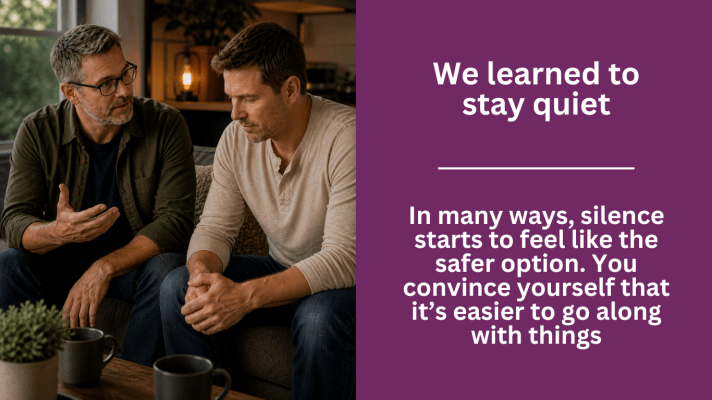
We learned to stay quiet
Most of us didn’t just wake up one day and decide not to speak up about what we need. That habit was learned over time, shaped by the environments we grew up in and the relationships we experienced along the way.
For some, it started in childhood. Being told not to be too much, not to ask for too much, or learning quickly that expressing needs didn’t always lead to being heard. For others, it developed later—through relationships where speaking up led to conflict, rejection, or emotional distance. Over time, it becomes easier to stay quiet than to risk rocking the boat.
In many ways, silence starts to feel like the safer option. You convince yourself that it’s easier to go along with things, to adapt, to keep the peace. And at first, it can even look like things are working. The relationship continues, there’s less tension, fewer difficult conversations.
But what’s really happening is something much quieter.
You begin to shrink.
Not all at once, but in small, almost unnoticeable ways. You stop asking for what you want. You filter your thoughts before they even have a chance to be spoken. You learn to prioritize someone else’s comfort over your own truth.
And eventually, it doesn’t feel like a choice anymore. It just feels like who you are.

The cost of not speaking up
At first, staying quiet can feel like it’s working. There are fewer arguments, fewer uncomfortable conversations, and a sense that things are moving along without disruption. It can even feel like you’re being easygoing, flexible, or supportive.
But over time, that silence starts to take a toll.
What you don’t say doesn’t disappear. It lingers. It builds. The small things you brushed aside, the preferences you never voiced, the moments where you chose comfort over honesty—they don’t go away. They settle in quietly, turning into frustration, resentment, or a vague sense that something isn’t quite right.
You may not even recognize it at first. It can show up as distance, a lack of enthusiasm, or a feeling of being disconnected from the very relationship you worked so hard to maintain. You start to feel unseen, even though you never gave anyone the chance to truly see you.
And that’s the difficult truth.
When you don’t speak up about what you need, you’re not protecting the relationship—you’re slowly removing yourself from it.
Over time, you begin to feel like a participant in something that no longer reflects who you are. You’re present, but not fully there. Engaged, but not fully expressed. And the longer that goes on, the harder it becomes to reconnect—not just with the other person, but with yourself.

The first time you said what you needed
I’ve been fortunate in my life to find someone who encourages me to share and follow my own needs. That hasn’t always been the case.
In too many past relationships, it felt like a struggle to even acknowledge what I needed, let alone express it. More often than not, I focused on pleasing the person I was with. When conversations came up about what we liked, what turned us on, or what we didn’t, I found myself listening to their preferences and quietly reshaping mine to match. If I was ever asked what I wanted, I was more afraid of losing the person—or being alone—than I was of losing myself, so I agreed with whatever they said.
I started to understand how damaging that was when I was dating Michael back in Virginia. I ignored the warning signs because I thought I was lucky to have found someone like him. Even in intimacy, I followed his lead, putting my own desires in the back seat and hoping maybe they’d be acknowledged later.
They weren’t.
My relationship with Karl is different. It’s something I consider sacred. He consistently asks what I want, what I’d like to try, and he shares his own needs openly. Do I do well with that? Not always. He’d tell you the same thing. But I’m trying. And more importantly, I want to try.
To be with someone who treats you as an equal—who sees your needs and genuinely wants to include them—is something I wasn’t used to. I still catch myself saying, “I can’t,” or “I don’t know how,” but the desire to show up differently is there… because of him.
And every time I do speak up, even in small ways, it creates a deeper connection between us. More than that, it helps me see my own worth within the relationship. For so long, I spent more energy comparing myself and questioning my value. But his patience and encouragement have shown me that there’s strength in being honest about what you want.
It turns something into an “us” experience, instead of something I’m just trying to maintain. For the first time, saying what I need doesn’t feel like a risk—it feels like a step toward something real.
And for that, I’m grateful.
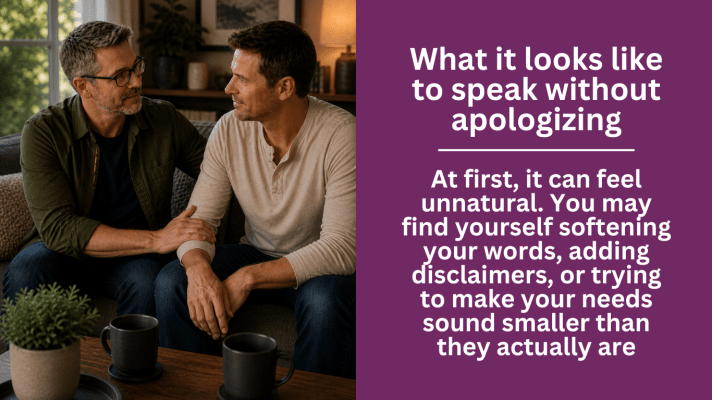
What it looks like to speak without apologizing
Learning to speak about your needs without apologizing doesn’t happen all at once. It’s not a switch you flip. It’s something you build over time, often in small, uncomfortable moments where you choose honesty over avoidance.
At first, it can feel unnatural. You may find yourself softening your words, adding disclaimers, or trying to make your needs sound smaller than they actually are. You might still worry about how they’ll be received, whether you’re asking for too much, or if speaking up will change the dynamic of the relationship.
But over time, something begins to shift.
You start to realize that expressing your needs doesn’t have to come from a place of fear or defensiveness. It can come from clarity. From simply stating what you feel, what you want, and what matters to you—without over-explaining or trying to manage the other person’s reaction.
And when you’re with someone who is emotionally available, something important happens in those moments.
You’re met with understanding instead of resistance. Curiosity instead of defensiveness. A willingness to listen instead of a need to correct or dismiss. It reinforces the idea that your needs aren’t a burden—they’re a part of building something real.
Speaking without apologizing doesn’t mean being demanding or rigid. It means being honest without shrinking. It means trusting that the right connection can hold space for both people, not just one.
Because at the end of the day, your needs aren’t the problem.
Staying silent about them is.
A big thanks to each and everyone of you. You all make GayintheCLE what it is and I could not do it without your support.


