
Humans often take one of their most important senses for granted… touch. We don’t really think about how this one small sensation gives us so much from the world around us. As children, we learn things are hot or cold by touch, we feel the warmth and love of our family through touch, and so many more. But that learning never really stops. Walking outside, we know what the weather is like by how it feels upon our skin. Even more importantly, we learn things like love and sexual gratification through touch.
Join me today as we look at Reclaiming Touch in a Body that has Changed and how we can learn from that to better interact with our loved ones, community, and to ourselves. Let’s get into it.
- When touch was about desire and performance
- When the body starts to change
- Reclaiming what touch actually means
- Touch as presence, not performance

When touch was about desire and performance
There was a time when touch felt tied directly to desire. It was about attraction, chemistry, and the unspoken understanding that physical contact meant something was going somewhere. A hand on an arm, a lingering glance, the way two people closed the space between them — it all carried expectation.
When you’re younger, touch often becomes a form of validation. It’s a way of knowing you’re wanted, that you’re attractive, that you’ve been chosen in some way. It feeds into the idea that connection is something you earn through how you present yourself, how you perform, and how you respond to the energy of someone else. It can feel exciting, but it can also feel like something you have to get right.
What I didn’t realize at the time is that when touch is tied so closely to performance, it becomes something you manage instead of something you experience. You’re thinking about how it’s being received, what it means, and where it’s leading — instead of simply being present in the moment.
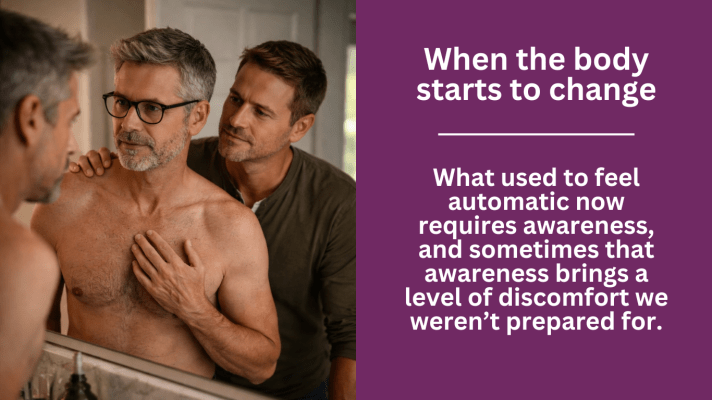
When the body starts to change
As we get older, our relationship with our bodies begins to shift. Things don’t feel the same, don’t respond the same, and don’t move through the world the way they once did. What used to feel automatic now requires awareness, and sometimes that awareness brings a level of discomfort we weren’t prepared for.
There’s also a growing sense of self-consciousness that can come with those changes. You start to notice things you didn’t before — how your body looks, how it feels, how it’s perceived by others. That awareness can create distance, not just from other people, but from yourself. You become more cautious, more reserved, sometimes even disconnected from the very thing that allows you to experience closeness.
In many ways, this is where touch starts to change whether we’re ready for it or not. It’s no longer just about attraction or instinct. It becomes something more layered, something that asks you to be present in a body that may not feel as familiar as it once did.
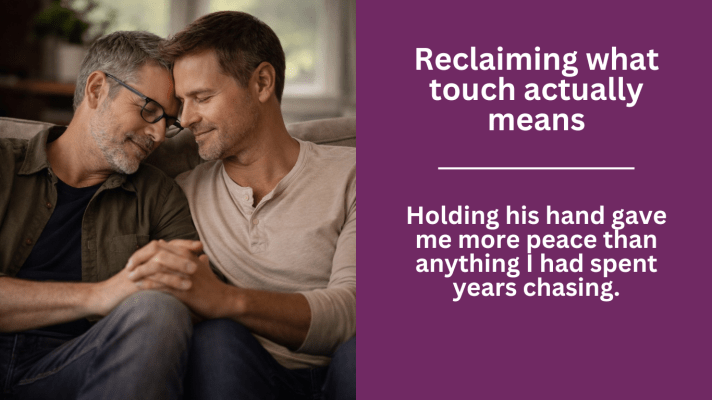
Reclaiming what touch actually means
I grew up with a father who wasn’t much for showing affection. As a kid, I was also made fun of for being a “mama’s boy” because I hugged my mother before leaving the house. Between those two things, I slowly started shutting down what would be considered affectionate touch.
Once I became sexually active, I learned quickly that some level of affection needed to be shown to make others comfortable. So I adapted. I offered it in small, controlled ways. Enough to meet expectations, but never enough to feel fully natural. But there were two moments in my life where those ideas were completely challenged.
In the late 90s and early 2000s, I joined a Native American group focused on learning and teaching pre-contact beliefs. They were incredible people, deeply committed to preserving their heritage and passing it on. When I attended my first camping outing with them, I had no idea what I was about to experience.
As I stepped out of my car and cautiously walked toward the camp, I was greeted by the person who had invited me. I extended my hand to shake hers. She laughed softly and said, “We don’t do that here. We’re huggers.” Then she pulled me into a full, tight embrace.
I had always been the kind of person who avoided physical closeness, uncomfortable with people entering my space. But in that moment, being held like that—by someone I had just met—didn’t feel invasive. It felt… safe. It felt warm. It felt like I belonged in a way I hadn’t realized I was missing.
Eighteen years later, I met Karl.
In the beginning, he was clear that he didn’t want a relationship. But I knew I wanted to be with him. I listened to his words, but I didn’t let them define how I showed up. When I touched him, I had to remind myself that it might not lead to anything—no relationship, no sex, no outcome I could control. But I still reached out.
As time passed and he became more open, something shifted in me. I started to realize that what I felt wasn’t coming from expectation—it was coming from presence. Looking into his eyes, hugging him, the simple act of reaching for him… it created a connection deeper than anything I had experienced before.
Weeks turned into months, and months into years. And somewhere along the way, I realized that holding his hand or simply sitting close to him gave me more peace than anything I had spent years chasing.
What I learned is that touch is essential to being human. With something as simple as a hand on an arm or a quiet embrace, a bond is created that words can’t replicate. It’s not about performance or expectation. It’s about connection. It’s about feeling safe, feeling seen, and feeling like you’re part of something bigger than yourself.
And for a long time, I didn’t even realize that was what I was missing.
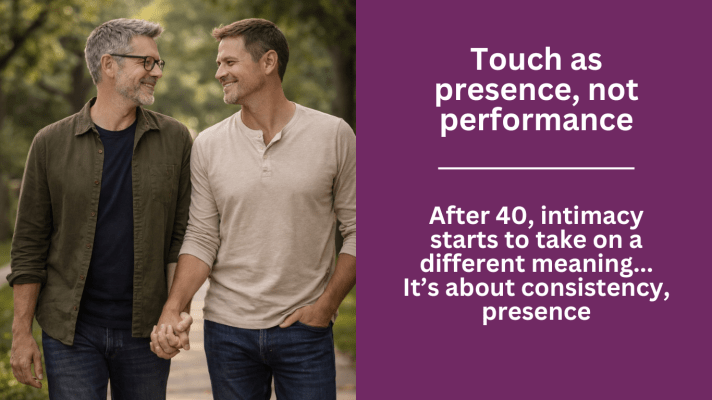
Touch as presence, not performance
Over time, something begins to shift. Touch stops being about what it leads to and starts becoming something valuable on its own. It becomes less about proving something and more about sharing something — a moment, a feeling, a sense of closeness that doesn’t need to be explained or justified.
When touch is rooted in presence, it feels different. There’s no pressure behind it, no expectation attached to it. It’s steady, grounded, and honest. It allows you to be where you are, with the person you’re with, without needing it to become anything more than what it already is.
That kind of connection doesn’t come from chemistry alone. It comes from being comfortable enough to let your guard down, to exist in your own body without judgment, and to allow someone else into that space without turning it into something you have to control.
After 40, intimacy starts to take on a different meaning. It’s not about intensity or immediacy. It’s about consistency, presence, and the quiet understanding that real connection isn’t something you perform — it’s something you allow.


