
Some years fade into the background. Others brand themselves into your story. 1985 was one of those landmark years for gay and bisexual men—especially those of us now in our 40s and 50s. Whether we were already questioning, newly out, or quietly observing from the sidelines, 1985 carved itself into our collective queer memory.
That year, the world felt bigger, louder, scarier—and more honest. In between the bright lights of ‘80s pop culture, there was a growing shadow that changed everything. 1985 marked a defining point in the HIV/AIDS epidemic, and whether we understood what was happening or not, we felt it.
- A view from a child
- The turning point: HIV/AIDS in 1985
- Visibility without safety: Growing up gay in 1985
- Pop culture wasn’t the center, but it was the atmosphere
- 1985 taught us who we were—and who we were up against
- A legacy that still lives in us
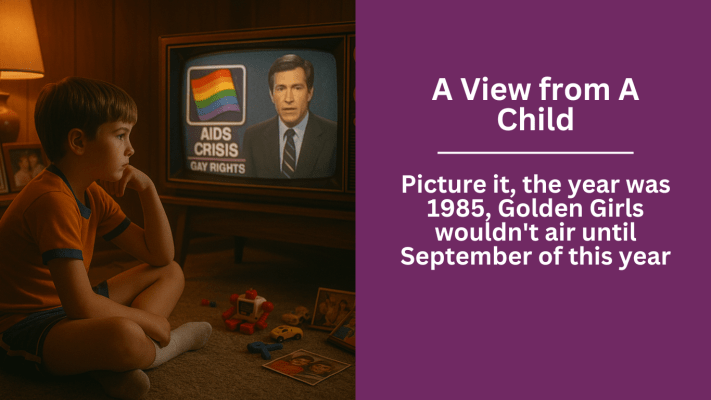
A view from a child
Picture it, the year was 1985, Golden Girls wouldn’t air until September of this year, George Michael was #1 with Careless Whisper, and Return of the Jedi left theaters.This year also saw other important events like the discovery of the lost wreck of the Titanic, Windows 1.0 was released and the famine in Ethiopia was all anyone talked about and gave rise to the first Aid performance with Live Aid. Most of this was lost on my younger self.
At this very point in my life, I would be turning twelve years old in August and it was my last year at Bethel Elementary School. I was wrapped up in thinking I was one of the cool kids and believed it with all my heart. This was also the year in which our entire class would go to Washington DC for a field trip and each of us would get to visit our next school, for the day.
This would be the year that I learned just how not cool…
A knock-off Members Only jacket and visor sunglasses wouldnt hide the fact that I came from a poor family and add to that my mother being a chaperone on our school trip and I was constantly teased as being a “momma’s boy.” (What self respecting gay kid isnt). Spending a day in middle school, far from the safe confines of Bethel Elementary taught me that I was a geek, to say the least. I remember that most kids came back from that visit feeling excited about moving on to 6th grade. Personally, I knew I was going to be the proverbial fish out of water and wanted to stay in the safety of places I knew. These were small points in all that was happening in the world in 1985.
Let’s go back in time, shall we?

The turning point: HIV/AIDS in 1985
You cannot talk about 1985 without talking about the impact of HIV and AIDS on the LGBTQ+ community. That year, the death of actor Rock Hudson from AIDS-related complications shook the world. For the first time, mainstream America was forced to confront the reality of this crisis—not as a distant rumor, but as something real, visible, and terrifying.
His diagnosis wasn’t just tabloid fodder. It put a face to AIDS for millions of people and pulled the disease out of the shadows, albeit into the harshest spotlight imaginable. For gay men, it was devastating. Many of us hadn’t even come out yet, and now we were being associated with a deadly illness we barely understood. The stigma of being gay and the fear of AIDS became intertwined, shaping how the world treated us—and how we saw ourselves.
That same year, the FDA approved the first HIV blood test, adding new layers of fear and urgency. Rumors swirled, discrimination intensified, and silence became survival for many. But beneath that silence, something else was growing: anger, resistance, and community action.

Visibility without safety: Growing up gay in 1985
For those of us growing up queer in 1985, visibility was a double-edged sword. On one hand, we were starting to see glimpses of ourselves in the world—coded references in movies, flamboyant performers, and unspoken bonds among peers. On the other hand, being openly gay in 1985 could still cost you everything—your job, your family, your safety.
In schools, being called “gay” was an insult. In churches, it was a sin. In politics, we were a target. There were no safe spaces, no affirming curricula, and no LGBTQ+ protections. And yet, we were watching, learning, and starting to find our strength.
That year, the roots of modern queer activism grew deeper. Organizations like GMHC (Gay Men’s Health Crisis)were expanding services, while smaller grassroots groups were forming in major cities across the country. Even if we weren’t part of them yet, they gave us something to believe in—a future we could fight for.
Pop culture wasn’t the center, but it was the atmosphere
While 1985 pop culture gave us glam, glitter, and temporary distractions, the real story was happening underneath. Sure, we remember the soundtracks and the fashion—the Walkmans, the neon, the shoulder pads—but those things existed in the background while we were absorbing something far more serious.
Movies and music were part of our lives, but for many LGBTQ+ individuals, especially during the AIDS epidemic, culture felt hollow without representation and justice. We clung to coded performances, to fierce women on stage, to glimpses of queerness in sitcoms and sci-fi, but we were also learning how to read between the lines. Even in entertainment, we were reminded of who wasn’t invited into the conversation.
Still, pop culture served its purpose. It gave us moments of joy, of fantasy, of escape. It offered emotional refuge when the headlines became too much. And sometimes, that escape was the only thing that kept us afloat.
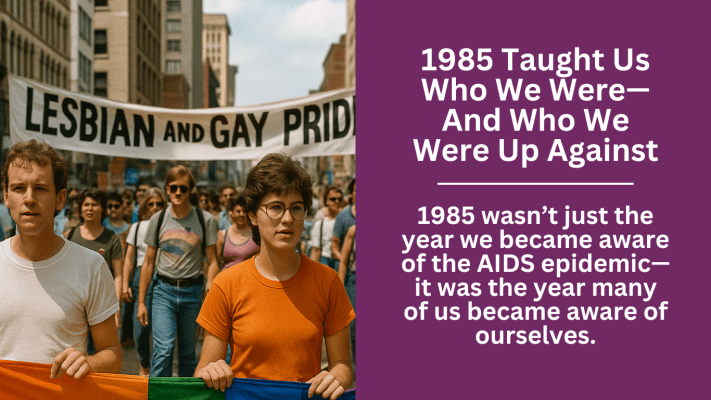
1985 taught us who we were—and who we were up against
By the end of that year, it was impossible not to feel the shift. 1985 wasn’t just the year we became aware of the AIDS epidemic—it was the year many of us became aware of ourselves. We began to understand that being gay wasn’t just a personal truth—it was a political identity. One that came with risks, assumptions, and expectations.
We were learning in real time what it meant to belong to a marginalized group. We were watching friends, celebrities, and strangers get sick, get shamed, and get ignored. But we were also witnessing the earliest forms of collective power—rallies, vigils, and the formation of what would become a national movement for LGBTQ+ rights.
1985 was the year grief started turning into activism. Quiet kids started growing into loud voices. Communities started to form in the cracks of loss. It wasn’t hopeful—but it was real.

A legacy that still lives in us
For gay and bisexual men over 40, 1985 isn’t just history—it’s part of our emotional DNA. It shaped how we love, how we trust, and how we protect each other. It taught us to question everything—authority, media, medicine, even ourselves—and to create meaning out of hardship.
The HIV/AIDS crisis didn’t end in 1985, but that year shifted the national conversation in ways we’re still reckoning with. And it awakened a generation of queer people to their strength.
If you were there, you remember. If you weren’t, you feel it in the legacy we still carry—in the healthcare systems we still navigate, the fights we’re still having, and the community care we still practice.
1985 changed everything. It still echoes. And it still matters.


 Gay in the CLE
1985 is the year I came out. Senior in high school, heading to college in the fall. It was a huge year for me – 40 years later looking back – it was monumental for the gay community and the world. Thanks for writing this!
LikeLike
Carlin,
Thanks for your comment. It is greatly appreciated and I am also glad this resonated with you. If you don’t mind my asking, how was it a huge year for you?
LikeLike
1985 I was a senior in high school in Denton, Texas. I figured out that I was into women and decided to pursue that path for myself. I fell in love with a woman for the first time. I started college in Oklahoma when AIDS was becoming a thing for the world. Joined the gay group campus and my roommate found out I was gay which was traumatizing (she was so mean to me after this). My parents found out I was gay and spent the next 25 years battling me over it from a fundamentalist christian perspective. It was my first year being a lesbian – and 40 years later, after a lifetime of being OUT, it was the most pivotal year in my life. 1985 for the win!
LikeLike