
I recently met someone who challenged my way of thinking, in a great many things. They come from a small town, much like I do, and has dealt with the small minded mentalities that seem to go hand in hand with those areas. They took these challenges and learned to navigate life on their own terms. While their beliefs are different than many, they are not without merit.
Growing up LGBTQ, we are constantly bombarded with hatred from all sides. Our very own families often tell us how we are going to hell for the people we choose to love. But what if that was not the only thing about you that was different than those around you. Imagine being a Romantic Satanist and living in a small town, all while being LGBTQ. Nick Grimshaw had did just that and wants to share their story with us. Join me as we look into Beyond the Horns: A Bisexual Man’s Journey in Romantic Satanism.
- The devil’s in the details
- Takin’ life by the horns
- The “darker side” of life
- A gathering of minds
- A road less traveled

The devil’s in the details
Nick Grimshaw,a 48 year old bisexual Romantic Satanist male, was born in the small southern town Bristol, Tennessee. Nick’s mother was raised Pentecostal and his father, who left him at an early age, was Methodist. Nick’s family wasnt overly religious but did express the views on those that were different than the lived they knew. Being LGBTQ and a Satanist, were the last things their parents had hoped for, in a child.
They saw how other LGBTQ people had been treated by those proclaiming their Christian faith. Instead of preaching “love the neighbor” they opted more for judging those that seemed different. This was the perfect breeding ground for a young Nick Grimshaw to realize the beliefs they have been raised with were not the loving environment that they had been led to believe.
Takin’ life by the horns
Thank you for talking to me, Nick. I guess the first question on everyone’s mind is, what is romantic satanism?
Yup, that it is. Most people get stuck on the “Satanist” part and probably think its all fire and brimstone, right? Not quite. It’s about the individualism,you see? No stuffy sky gods dictatin’ your every move. It’s about the power of the self, the beauty of the dark side. It’s about not shying away from the darker aspects of life. Makes the light all the sweeter, don’t it? It ain’t your typical devil worship. Romantic satanism is more about finding yourself, embracing your own darkness. See, the old goat – that’s what some folks call him, he rebelled against the big guy upstairs, right? Stood up for what he believed in, even if it meant getting tossed out of heaven. That’s the part that resonates with me, the rebellion against blind obedience.
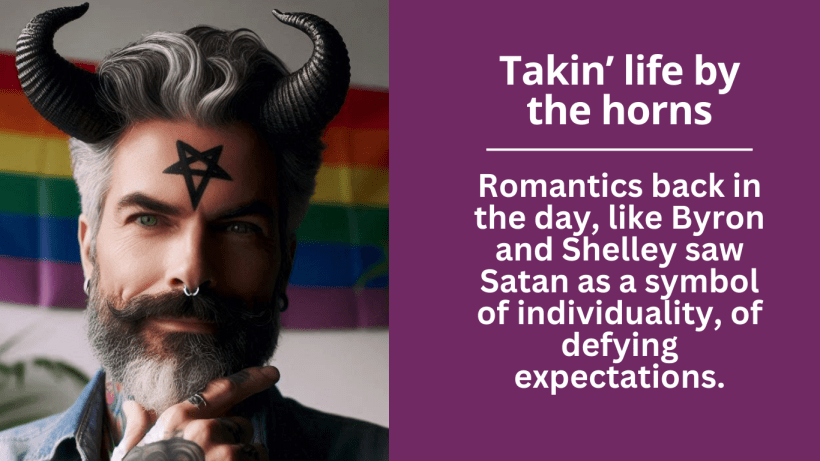
Romantics back in the day, like Byron and Shelley saw Satan as a symbol of individuality, of defying expectations. That’s how it feels to me, too. It’s about carving your own path, even if it’s a bit dark and twisty at times. We all got a bit of darkness inside, wouldn’t you say? It’s about accepting that and using it to fuel your creativity, your passion. It ain’t about evil, more like embracing the full spectrum of who you are.
There’s a real sense of beauty in romantic satanism too. The night sky, the power of a storm, the forbidden fruit – all that stuff holds a certain allure, a sense of mystery. It’s about appreciating the darker aspects of the world, the things that some folks might shy away from.
Does that make some sense? It’s not some cult, mind you. There’s no devil-worshipping rituals or anything like that. It’s more of a personal philosophy, a way of looking at the world.
That does sound nice, to be able to live life on your terms and not be defined by someone else’s ideals. You mentioned not shying away from life’s darker aspects, can you elaborate on that a little more?
Absolutely. See, life ain’t all sunshine and rainbows, even in Bristol. There’s loss, there’s pain, there’s the inevitable march of time towards that big sleep. Most folks spend their lives tryin’ to ignore it, pretend it doesn’t exist. But romantic satanism, well, it says acknowledge it. Stare that darkness right in the face. Doesn’t mean wallow in it, mind you. But by acknowledging the darkness, you kinda give it its due. Makes the light all the more precious, the good times all the sweeter.
Now, for me, facin’ the darkness has meant different things at different times. When I was younger, it was grappling with bein’ bi in a place where that wasn’t exactly celebrated. It was about learnin’ to accept myself, the whole package, even the parts that society might see as “wrong.” It was about findin’ my own tribe, folks who understood what it meant to walk a different path.
The older you get, the darkness takes on new shapes. It’s a harsh mistress, that darkness, but it can also be a powerful motivator. Makes you appreciate the time you have left, the relationships you cherish. It pushes you to live a bit more intensely, to not waste your days on things that don’t truly matter.
Now, it ain’t for everyone, this facin’ the darkness. Some folks need that comfort of a pre-defined path, a light at the end of the tunnel. But for me, romantic satanism gives me the space to explore it all – the good, the bad, the downright ugly.Makes life a damn sight more interesting, that’s for sure.
You said that Romantic Satanism wasn’t like what people think. That it isn’t about devil worship. Then why call yourself a satanist? Its such a divisive word, isn’t it?
You hit the nail on the head there. It is a divisive word, “Satanist.” And yeah, I can see why it might throw folks off,especially considering what most people think it means. Here’s the thing – the word “Satan” has a lot of baggage, centuries worth of religious condemnation piled onto it. But for us romantic satanists, it’s more about reclaiming that symbolism, using it for our own purposes. It has its own power to it, doesn’t it? It grabs the attention, sparks curiosity, and sometimes a little provocation can be a good thing. It gets people thinking and questioning, hopefully,
Think of it like this: the devil, in Christian tradition, is the rebel, the trickster who dared to question authority. Romantic satanists take that image and run with it. We see it as a symbol of independence, of thinking for yourself, even if it shakes things up a bit.
But here’s the most important thing: romantic satanism isn’t about devil worship. It’s not about rituals or sacrificing chickens (though, let’s be honest, who needs the mess?). It’s a personal philosophy, a way of navigating the world that embraces the darkness within, the parts of ourselves that society might try to repress. It’s a way to reclaim a symbol, to make it our own.
You mentioned rebellion against blind obedience, did you start your journey with romantic satanism when you were growing up in your small town? How did you find out about it?
Not exactly. See, Bristol wasn’t exactly a hotbed of philosophical exploration. Most folks here followed the same path their parents and grandparents did, religion and all. But there was always a part of me that craved somethin’ more, somethin’ that questioned the status quo.
It started with books, like you wouldn’t believe. The town library was my escape, a place where different ideas swirled around like dust motes in a sunbeam. I devoured the classics, those brooding Romantics like Byron and Shelley. Their characters, their defiance of authority, that resonated with me. It was like they were speakin’ directly to my teenage angst.
It wasn’t some organized thing, mind you. No secret meetings or devil horns. It was more like a way of seein’ the world, a philosophy I cobbled together from those dusty library books and late-night record sessions.
So yeah, Bristol might not have offered much in the way of overt romantic satanism, but it gave me the space, the quiet desperation, to crave somethin’ different. And that, in a roundabout way, led me to find my own personal rebellion, my own darkness to embrace.

The “darker side” of life
You mentioned being bi and grappling with it in a place where it wasn’t exactly celebrated, can you tell me about growing up in your small town?
Growing up, I never really fit in any one box. Liked girls, sure, but then there was this fella down by the creek, with eyes as green as a summer storm, who made my heart skip a beat. There weren’t any words for it back then, not in Bristol anyway. Just a vague sense of confusion, a feeling like I was speakin’ a different language than everyone else.
Bristol’s a good place, don’t get me wrong. Everyone knows everyone, there’s a strong sense of community. But bein’ bi in a place like that? Let’s just say it was like tryin’ to find a black rose in a field of dandelions. There just weren’t many folks who understood, or maybe they did and just kept it buried deeper than a farmer’s winter stash.
The real struggle was with the boys, the ones who thought masculinity was a straight line and nothin’ else. There were taunts, of course, the usual playground fare. But it was the silences that hurt the most. The way folks would clam up when I mentioned a cute girl, the forced coughs and nervous glances when a certain boy caught my eye.
It wasn’t all bad, mind you. My folks, bless their hearts, tried their best. They weren’t exactly bastions of liberalism, but they loved me fiercely. My mom, a quiet woman with a kind smile, would always remind me that love is love, even if it looked a little different than what the preacher was spouting on Sundays.
Eventually, I found my people, but online, in those early internet chatrooms. Folks who understood, who celebrated the full spectrum of love and identity. It wasn’t a replacement for real-life connection, but it was a lifeline, a way to know I wasn’t alone. Looking back, Bristol shaped me, for sure. It taught me resilience, the importance of finding your own truth, even when the world seems determined to shove you into someone else’s story.
When did you realize that you were into more than just women and was that around the same time you adopted this new philosophy?
It wasn’t a lightbulb moment, that’s for sure. Growing up in Bristol, with its limited exposure to different lifestyles, things were more of a fuzzy exploration than a clear-cut realization.
Like I mentioned, there were always these confusing feelings, a flutter in my chest that wasn’t reserved solely for the girls in my class. It wasn’t like a conscious choice, more of a subconscious pull towards a certain energy, a shared spark. But without any words to describe it, without any role models, it just felt like a confusing anomaly.
This internal exploration definitely overlapped with my discovery of romantic satanism. There was a connection, a sense of embracing the unconventional that resonated with my own struggle to understand my sexuality. Here was this philosophy that championed individuality, that defied categorization. It gave me the courage to start questioning the narrow definitions of love and attraction that swirled around me in Bristol.
The internet, a godsend in those days, opened a whole new world. Chatrooms with folks who used words like “bisexual” and “fluid” for the first time. It was a revelation, a sense of belonging I hadn’t known I craved. It wasn’t Bristol offering these answers, but it was the quiet yearning for something different that led me to find them elsewhere.
So, to answer your question, it wasn’t a single moment of realization, but a gradual exploration fueled by both internal confusion and the external influences of romantic satanism. It was about embracing the darkness, the parts of myself that didn’t fit the mold, and finding the courage to live authentically, whoever that person might be.
Have you been open about your beliefs with the people you have dated and, conversely, have you been open about your sexuality with other Romantic Satanists you met?
With folks I’ve dated, it’s always been a case-by-case situation. Bristol, bless its heart, ain’t exactly a haven for open discussions about Satanism, let alone bisexuality. So, in the early days, yeah, there was a certain amount of tiptoeing around it.
But as I got older, and more comfortable in my own skin, I found partners who appreciated my honesty. They might not have understood the whole romantic satanism thing, but they dug the fact that I marched to the beat of my own drum. The music, the books, the whole rebellious spirit – that often ended up being a conversation starter, a way to connect on a deeper level.
There’s still a certain discretion, mind you. You don’t exactly advertise your romantic satanism on a first date, even in the most progressive circles. It’s a balancing act, for sure. But hey, that’s life, ain’t it? Finding your tribe, your people, while still navigating a world that often wants to put you in a box.
Were there any past romantic partners in your life that didnt react well to your beliefs?
Oh, there were definitely a few bumps along the road, wouldn’t be much of a story without them. Here in Bristol, traditional values run deep, and romantic satanism, well, let’s just say it raises more than a few eyebrows.
There was Sarah, back in high school. Sweet girl, loved her laugh that could light up a room. But when I hesitantly mentioned reading about LaVey (founder of the Church of Satan), her smile vanished faster than a snowflake on a hot stove. Ended up in a tearful conversation about “dark influences” and “finding the right path.” We drifted apart after that,which stung, but at least it was honest.
The worst was probably Michael. We clicked right away, a whirlwind romance full of late-night talks and stolen kisses. But after a few months, the cracks started to show. He’d make jokes about my “devil worship,” dismiss my interest in Satanic philosophy as just a phase. It chipped away at the foundation of trust, turned those late-night talks into arguments about misunderstood symbols and misplaced fears.
Looking back, those experiences were tough, but they taught me valuable lessons. They showed me the importance of finding partners who celebrate my whole self, the darkness and the light. They forced me to be upfront about my beliefs,to not shy away from who I am.
Yes, life can definitely feel like a bag of mixed candy, sometimes. You never know what you may get.
Aye, that’s a right, good analogy. Sweet treats and sour surprises all jumbled together. But hey, that’s what keeps things interesting, wouldn’t you say? So, you got any more questions for Nicky here? The world of a romantic satanist bi dude in a small town is a curious one, full of unexpected twists and turns.
A gathering of minds
You mentioned that you have met others at gatherings. Do Romantic Satanists go to church? Do you congregate on a regular basis?
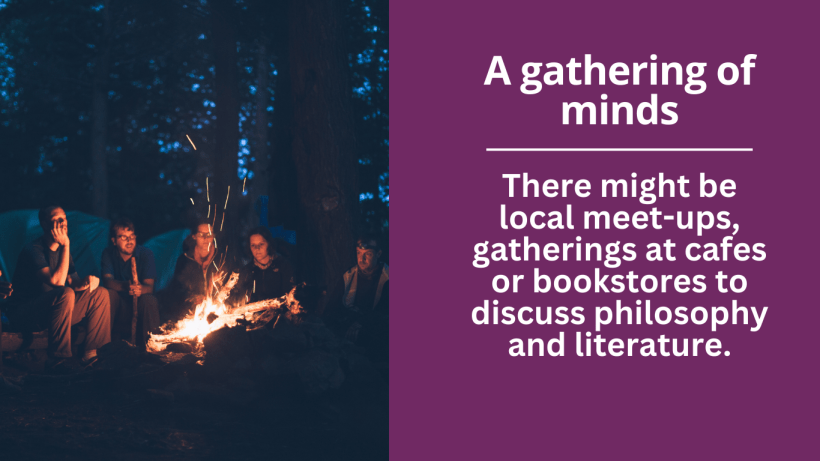
Hold on there, partner. Romantic Satanism ain’t exactly a church-going crowd. We don’t have weekly sermons or sing hymns about the devil. Think of it more like a loose network of folks who share a similar outlook on life. There might be local meet-ups, gatherings at cafes or bookstores to discuss philosophy and literature. Maybe even the occasional weekend retreat in a secluded cabin, surrounded by nature and fueled by intellectual discourse (and perhaps a bonfire, who doesn’t love a good bonfire?).
The internet plays a big role too, online forums and chatrooms where romantic satanists from all corners of the globe can connect, share ideas, and find a sense of community. There’s a certain discretion that comes with the territory, especially for folks who live in conservative places, where whispers of “devil worship” can travel faster than a speeding mullet.
So, the answer is no, not church in the traditional sense. But there are ways for romantic satanists to connect, to share their experiences and find support from others who understand the allure of the darkness, the beauty of rebellion, and the power of embracing your own unique path.
I can see how discretion can be important, especially given the reactions most people have to the word “Satanist.” But there are churches that are dedicated to Satanism. There is the Church of Satan and The Satanic Temple, correct? What are your thoughts on them?
You’re right, there are definitely organizations out there with “Satan” in the name, but they’re not exactly what romantic satanism is all about. Here’s the breakdown:
- The Church of Satan (CoS): Founded by Anton LaVey in the 1960s, the CoS is considered the OG of Satanism.They focus on individualism, self-interest, and a rejection of traditional religion. They see Satan as a symbol of rebellion and pride, not a literal being. There’s a strong emphasis on reason and logic, and their rituals are more like psychological dramas than anything supernatural.
Now, the CoS is a structured organization with membership requirements and all that jazz. While there might be some overlap with romantic satanism in terms of embracing individuality, it’s a more formal approach. Romantic satanism is more of a personal philosophy, a way of viewing the world, not necessarily a membership club.
- The Satanic Temple (TST): This one’s a whole different beast. Founded in 2013, the TST is more about social activism and promoting secularism. They use Satanic imagery ironically to challenge religious authority and fight for separation of church and state. They’ve done some pretty interesting stuff, like putting up Baphomet statues next to government buildings to highlight hypocrisy.
While I can appreciate their activism and their fight for religious freedom, the TST doesn’t really resonate with me on a personal level. Romantic satanism is more about introspection, about finding your own truth in the darkness. The TST is more outward-facing, using satire and social commentary to make a point.
So, both the CoS and the TST have their merits, but they’re not quite the same as romantic satanism. We share some common ground, sure, but romantic satanism is more of a personal exploration, a way of navigating life that embraces the shadows and celebrates the power of being your own unique self.
So, do you affiliate with either of them?
Me, affiliate? Not exactly. Like I said, romantic satanism is more of a personal philosophy, a way of lookin’ at the world through a certain lens. It ain’t about memberships or attending specific gatherings.
The Church of Satan, with its emphasis on LaVey’s ideas and structured approach, feels a bit too rigid for me. Don’t get me wrong, I admire their focus on reason and individuality, but it’s a bit too organized for my tastes.
The Satanic Temple, on the other hand, is all about social activism, which is a noble pursuit, for sure. But their use of Satanic imagery for political commentary doesn’t quite fit with my personal journey. It’s more about external change,while romantic satanism is more about internal exploration.
So, I guess I’m a bit of a lone wolf, pickin’ and choosin’ what resonates with me from different sources. I find inspiration in the writings of those old Romantics, in the defiance of Black Sabbath’s music, and in the philosophy of thinkers who question the status quo.
Maybe someday, there’ll be a “Romantic Satanist Association,” but for now, I’m content to carve my own path, to embrace the darkness on my own terms. It’s a solitary path at times, but it’s a path that feels authentic, you know?
If you had the ability to change the mind of a person about romantic satanism, how would you explain it to them so that they could understand it better?
If I wanted someone to understand romantic satanism, I wouldn’t focus on the word “Satan” itself. It’s loaded with baggage, conjuring images of fire and brimstone. Instead, I’d try this approach:
- Start with the Individual:
Explain that it’s about embracing your own unique journey, questioning societal norms, and carving your own path.We all have a bit of darkness within us, a sense of rebellion against expectations. Romantic satanism is about acknowledging that darkness, not fearing it. - Embrace the Duality:
Life isn’t all sunshine and rainbows. There’s loss, pain, and the inevitable darkness of mortality. Romantic satanism doesn’t shy away from that. It acknowledges the darkness as a part of life, and uses it to appreciate the light all the more. It’s like appreciating the beauty of a starlit night because you understand the vast darkness of space. - Find Inspiration in the Arts:
Talk about the Romantics – poets like Byron and Shelley – who defied societal norms and found inspiration in the darker aspects of life. Mention how some musicians, like Black Sabbath, use themes of rebellion and darkness to create powerful art. - It’s Not About Devil Worship:
Make it clear that there’s no devil worship or sacrificing animals. It’s a personal philosophy, not a religion with rituals or blind faith. It’s about self-reflection, finding your own truth, and using the darker aspects of life to fuel your creativity and individuality. - Focus on Personal Growth:
Explain how romantic satanism can be a tool for personal growth. It encourages you to confront your fears, explore the unknown, and ultimately become a more authentic and self-aware person. It’s about self-reliance, critical thinking, and finding strength in being different.
By focusing on these points, I hope someone could see romantic satanism not as devil worship, but as a way of embracing the complexities of life and finding your own truth in the darkness.
A road less traveled
Nick, thank you for taking time today to discuss you and your beliefs. I feel the only way any of us can learn to be better is by exposing ourselves to different beliefs, people, and ideas. I hope this helps someone out there to see Romantic Satanism and people in just a little better light. Do you have any thoughts that you would like to pass along to my readers?
Aye, thanks for havin’ me. It ain’t often a bloke from Bristol gets to chat about romantic satanism with someone who’s genuinely interested. To your readers, I’d say this: don’t be afraid of the darkness. It’s a part of life, just like the light. Embrace it, understand it, and you might just find a strength you never knew you had.
As for romantic satanism, well, it ain’t for everyone. But if you’re lookin’ for a way to question the status quo, to carve your own path, and to find beauty in the shadows, then maybe it’s worth lookin’ into. Just remember, it ain’t about worshiping the devil, it’s about worshiping yourself, your own unique spirit, darkness and all.
I would like to thank Nick Grimshaw for sharing his life and beliefs. Being different in this country and age can be fraught with peril, especially if you aren’t careful. What about you, my readers, are you beliefs in opposition to how you were raised? What are yout thoughts on Romantic Satanism? Have you ever heard of it and/or how do you feel about it? Maybe you grew up in a small town, as well, and can speak to how hard it was to be who you were, at a young age. Let me know in the comments below. As always, thanks to each and everyone of you for being a part of GayntheCLE.


 Gay in the CLE
one take away “. It’s a personal philosophy, a way of navigating the world that embraces the darkness within, the parts of ourselves that society might try to repress. It’s a way to reclaim a symbol, to make it our own.” grabbed me…and aligns and find reassuring as i get older to keep exploring. love the post and re reading …kenny
LikeLiked by 1 person
Kenny, thanks for your words and I am glad that Nick’s story resonated with you in some way. He has a few posts that he is doing in the future, so be sure to keep a watch for his unique approach to life. Keep exploring and learning, it’s how we grow.
LikeLiked by 2 people
Thank you. Appreciate the response
LikeLiked by 1 person
“Romantic satanism is more of a personal philosophy, a way of viewing the world, not necessarily a membership club.”
This speaks to me and aligns with where i’d like to delve further.
LikeLiked by 2 people
Thank you for your comment. What about the article speaks to you?
LikeLiked by 1 person