
Somewhere along the way, we were taught to fear midlife. The phrase “midlife crisis” gets tossed around like a warning label, as if reaching your forties and fifties automatically sends your life into chaos. A sports car, a bad decisions, some desperate attempt to feel young again. But the more I’ve lived through these years, the more I’ve come to believe that the phrase misses the truth entirely. Midlife isn’t a crisis. It’s something far quieter and far more honest, a reckoning with the life you’ve actually lived and the truths you can no longer ignore.
Turning fifty, being diagnosed with Cirrhosis, and seeing where my life is now, in comparison to where I thought my life would be, is vastly different. Like many others, I have started trying to detangle that myth and find my new balance. Midlife isn’t a crisis, it’s the moment the stories we believed about our lives stop working.
Let’s take a look at Midlife Isn’t a Crisis – It’s a Reckoning With the Truth.
- The Moment You Realize Something has Changed
- The Myth of “Mid-Life Crisis”
- When the Stories Stop Working
- The Freedom Hidden Inside the Reckoning
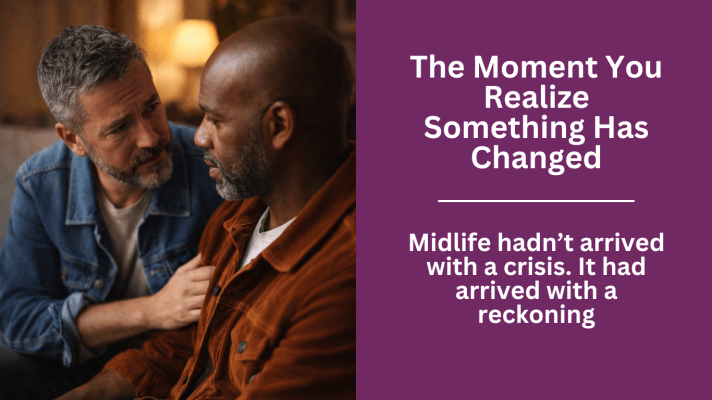
The Moment You Realize Something has Changed
For me, the moment didn’t arrive with some dramatic realization about aging. It came during a conversation with my boyfriend, Karl. It was one of those conversations that starts quietly and then slowly becomes emotional before you realize what’s happening.
I had been talking about my health the way I always had, as something I needed to manage, something I needed to figure out, something I needed to control. In my mind, it was my responsibility and mine alone. Karl listened for a while and then said something that caught me completely off guard. He told me that my health wasn’t just my issue anymore. It was our issue.
At first, I resisted that idea. I had spent most of my life believing that being responsible meant handling my problems on my own. If something went wrong, I fixed it. If something was difficult, I pushed through it. That mindset had carried me through a lot of years, and I thought it was the right way to approach life.
But Karl wasn’t arguing with me about responsibility. He was pointing out something I hadn’t fully accepted yet, that the choices I make about my health, my habits, and my future don’t just affect me anymore. They affect the life we are building together.
That conversation stayed with me long after it ended. Not because it was confrontational, but because it forced me to see something I hadn’t been ready to admit.
Somewhere along the way, life had changed.
Midlife hadn’t arrived with a crisis. It had arrived with a reckoning, the quiet realization that the stories I had always believed about independence, control, and time itself were no longer entirely true.
The Myth of “Mid-Life Crisis”
For decades, culture has treated midlife like a punchline. The phrase “midlife crisis” usually comes wrapped in some predictable image, the guy chasing youth in ways that make everyone around him roll their eyes. It’s framed as desperation, instability, or vanity. Something to laugh at rather than something to understand.
But that stereotype flattens what midlife actually feels like for most people. It reduces a complex stage of life into a cliché about poor decisions and wounded egos. The reality is far less dramatic and far more honest than that. Most people I know who are moving through their forties and fifties aren’t trying to reclaim their youth. They’re trying to understand their lives.
The truth is that what gets labeled a “crisis” is often just awareness. It’s the moment when the pace of life slows down enough for you to see things clearly. You start to recognize where your expectations didn’t match reality, where time has moved faster than you realized, and where the choices you made, good or bad, have shaped the life you’re standing inside now.
That kind of realization can be uncomfortable, but it isn’t a breakdown. It’s something quieter and more honest. Midlife isn’t where life suddenly falls apart. It’s where many of us begin to see it clearly for the first time.
When the Stories Stop Working
What people call a midlife crisis is often just the moment when you can no longer outrun the truth.
For most of your younger lives, we move forward with a quiet confidence that things will eventually work themselves out. We make plans, set goals, and tell ourselves stories about where those choices will lead. Careers will stabilize. Relationships will fall into place. Our bodies will keep up if we take care of them. And even when something goes wrong, we assume there will always be time to adjust course. And for a long time, those stories work well enough that we rarely question them.
Midlife has a way of challenging those assumptions.
At some point you begin to notice that some of the stories you carried for years no longer explain the life you’re living. The timeline you imagined doesn’t look the same anymore. Priorities shift. The future stops feeling infinite, and the decisions you make start to carry a different kind of weight. It isn’t necessarily dramatic, but it is undeniable.
For me, that reckoning became impossible to ignore when my health entered the picture in a serious way. Being diagnosed with cirrhosis forced me to confront realities I had spent most of my life assuming I could outwork, outrun, or outsmart. I had always believed that discipline and determination could solve almost anything if you pushed hard enough. But biology doesn’t negotiate with optimism.
What I began to understand slowly, and not always gracefully, is that midlife doesn’t just reveal our limitations. It reveals our truths. The truths about what matters, what doesn’t, and what parts of the life we imagined were never guaranteed to begin with.
That realization can feel unsettling at first. But it’s also the beginning of something far more honest than the stories we once relied on.

The Freedom Hidden Inside the Reckoning
Once the initial discomfort settles, something surprising begins to happen. The same clarity that made midlife feel unsettling at first can also start to feel liberating. When the stories we once relied on stop working, we’re forced to look more honestly at what actually matters in our lives.
That honesty changes how we move through the world. Priorities become simpler. The pressure to chase expectations that were never truly ours begins to fade. Instead of trying to force life back into the shape we once imagined, we start asking different questions. What do I really want from the years ahead? What relationships deserve my attention? What parts of my life are worth protecting, and what parts can I finally let go?
In many ways, this is the quiet gift of midlife. The illusions that once made life feel limitless also made it easy to avoid difficult truths. When those illusions fall away, what remains may be smaller than the life we once imagined, but it is also more honest.
Midlife isn’t where life falls apart, it’s where the illusions finally fall away. And once those illusions fall away, the harder work begins, learning how to sit honestly with the feelings we spent years trying to outrun.
Thank you to each and everyone one of you. You make GayintheCLE possible and I truly appreciate each and everyone of you.


 Gay in the CLE