
As we move further into midlife, keeping up with your health can start to feel more anxiety-inducing than comforting. Add in a diagnosis that requires regular monitoring, and that anxiety multiplies quickly. Take it from experience — burnout can creep in long before you realize it’s happening.
There’s a fine line between vigilance and hyperfixation. Between being informed and turning into your own late-night internet specialist. Somewhere in that space, we’re supposed to maintain mental, physical, and emotional stability.
That sounds manageable on paper.
It wasn’t for me. But I am slowly changing how What Health Anxiety Taught Me About Control.
- When Being “A Good Patient” Undermines Your Health
- The Illusion of Control
- When Energy Enters the Picture
- The Cost of Living in Surveillance Mode
- Stability Without Surveillance
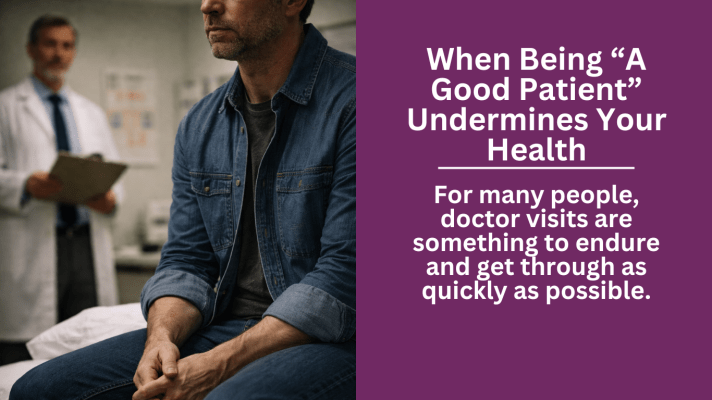
When Being “A Good Patient” Undermines Your Health
I’ve shared a lot about cirrhosis and aging. I’ve tried to pass along what I’ve learned. But let me be candid for a moment.
When I first received my diagnosis, I was terrified. I didn’t want to think about it. Part of me didn’t even want to try to change anything. I felt like the decision had already been made, that this was the consequence of past choices and now I simply had to endure it.
After sitting in that fear for a while, I made a different decision. Life is better lived than wasted in grief. So I went into action.
I researched everything. I researched diets, exercise, lifestyle changes, possible reversals, even whether there was a way to cure myself. After every appointment, I analyzed my labs and dissected my doctor’s notes. I documented symptoms, tracked changes, and memorized warning signs. I was determined to catch anything before it caught me.
It didn’t bring peace.
It brought mental fatigue and restless nights.
My boyfriend tried to get me to relax, but all I could see was an expiration date hovering somewhere in the distance. I believed I had to do everything perfectly to make sure it never arrived before I was ready. I became intense. Focused. Aggravated. That focus bled into arguments and distance, because I convinced myself no one else could understand the weight of what I was carrying.
I told myself this was what responsible patients did.
In reality, it was exhausting.
I thought I was being vigilan, like some dark superhero watching over a crumbling city. Dramatic? Yes. But that’s how it felt. I saw danger everywhere. And I believed constant attention was the only thing standing between me and collapse.
Slowly, I began to understand that if I truly wanted to stay healthy, this mindset had to change.
The Illusion of Control
When you’re newly diagnosed, research feels productive. You build systems. You track numbers. You document everything.
I used my Apple Health app to log how I felt emotionally and physically. Every symptom went in. If something worried me, I journaled through it. I built folders in my Notes app filled with information; causes, treatment options, dietary plans, symptom checklists. I kept a running list of questions for every appointment.
I was searching for something, anything, that would offer relief. Some piece of knowledge that would quiet the fear long enough for me to breathe.
Instead, I kept feeding it.
Then came the appointment that shifted everything.
For the first year, my MELD score held at a six. I lost nearly 100 pounds in eight months. I implemented every lifestyle change I could. I believed I had figured it out. For context, a MELD score of six is as stable as you can realistically be while living with cirrhosis. It means the liver is still functioning in a mostly normal range.
I thought maybe I could push it lower.
When my doctor told me my MELD score had increased to seven, it felt like the floor dropped out beneath me.
But I did everything right.
I researched.
I adjusted.
I disciplined myself.
How did I go backward?
She smiled, genuinely, and said, “You can work and study all you want. Your body will still do what it does. You can’t control much of that. And your score moved from six to seven on a scale of six to forty. You are doing well.”
I was too stunned for her words to land in that moment.
But they stayed with me.
They still echo.
“You can do everything right and biology will still move at its own pace.”
That was the first crack in the illusion.
The long game isn’t about winning every number.
It’s about sustainability.
When Energy Enters the Picture
What I didn’t fully understand at the time was how tired I had become.
Not just physically, though that was part of it. Mentally tired. Emotionally stretched thin. My days revolved around monitoring, adjusting, and anticipating. I wasn’t simply living with cirrhosis; I was managing it like a second full-time job. Every ache carried meaning. Every mood shift required interpretation. Every quiet evening became an opportunity to research one more article, read one more forum, check one more statistic.
I told myself this was discipline. Responsibility. Maturity.
But discipline without boundaries becomes depletion.
The more I tried to control my health, the less energy I had for everything else. Conversations felt shorter. My patience thinned. Joy started to feel conditional — something I could only enjoy once I was certain nothing else was wrong. If I wasn’t researching, I felt negligent. If I was researching, I felt anxious. There was no rest built into the system I had created.
Health anxiety doesn’t just live in the mind.
It drains the body.
When your energy is already limited, whether from age, chronic illness, stress, or just the accumulated weight of living, constant vigilance becomes unsustainable. Exhaustion lowers your emotional resilience. It makes uncertainty louder. It convinces you that you must push harder when what you actually need is margin.
I wasn’t just trying to control my condition.
I was trying to outrun uncertainty.
And it was costing me more energy than the disease ever had.
The Cost of Living in Surveillance Mode
Living in constant monitoring changes you.
It narrows your world in ways that are subtle at first. Conversations become filtered through health. Plans are evaluated based on energy output. Even joy becomes conditional — allowed only if nothing feels “off” that day. I wasn’t just managing cirrhosis. I was scanning for collapse.
And when you live that way, the people around you feel it.
My boyfriend felt it. Friends felt it. Every interaction carried a layer of tension because part of me was never fully present. I was there physically, but mentally I was calculating, anticipating, analyzing. I told myself I was being careful. What I was actually being was unavailable.
Surveillance mode makes everything feel urgent. A small ache becomes a signal. A bad night of sleep becomes a warning. A minor lab shift becomes a narrative about decline. The nervous system never fully rests. And when your nervous system never rests, neither do you.
The hardest realization wasn’t that I couldn’t control my biology.
It was recognizing how much of my life I was missing while trying to.
Control had quietly shrunk my world.
And that was a cost I hadn’t accounted for.
Stability Without Surveillance
I still monitor my health.
I still track labs. I still prepare questions. I still pay attention to changes in my body. Ignoring reality isn’t strength — it’s denial. But I no longer treat every fluctuation like a threat.
There is a difference between attention and obsession.
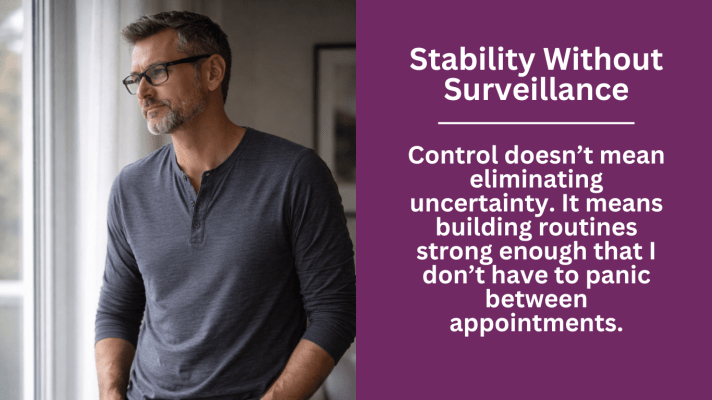
Control doesn’t mean eliminating uncertainty. It means building routines strong enough that I don’t have to panic between appointments. It means doing what’s required — and then stepping back. Letting the numbers exist without interrogating them every night. Letting my body move without assuming it’s collapsing.
Acceptance hasn’t meant giving up control. It has meant redefining it.
Control used to mean knowing everything. Now it means managing what is mine to manage and allowing the rest to unfold without turning it into catastrophe. It means protecting my energy as carefully as I protect my lab values.
My health will change. My body will age. Biology will continue doing what it does.
But I don’t have to live in surveillance mode to survive it.


 Gay in the CLE