
Fear of going to the doctor is a big issue faced by roughly 39% of the American population. So it should come as no surprise that at a recent medical visit, I noticed a section in my chart that said, “patient has severe ‘white coat syndrome.’” What this means is that when I’m in a doctor’s office, my blood pressure tends to read higher than it does at home. One in every five adults experiences this. And it’s not hard to understand why. You schedule a medical appointment because something feels off. You worry about what it could be, then worry about what the doctor might say, and when you add in cost and potential procedures, fear escalates quickly.
Join me today as we talk about doctor visits, fear, and learning to advocate for yourself after 40.
- The Quiet Fear of Doctor Visits After 40
- When Being a “Good Patient” Undermines Your Health
- Advocating for Your Health vs. Trying to Control Outcomes
- Learning to Speak Clearly at Doctor Visits When Fear is Loud
- Choosing Presence Over Avoidance in Midlife Healthcare
- Advocating for Long-Term Health After 40
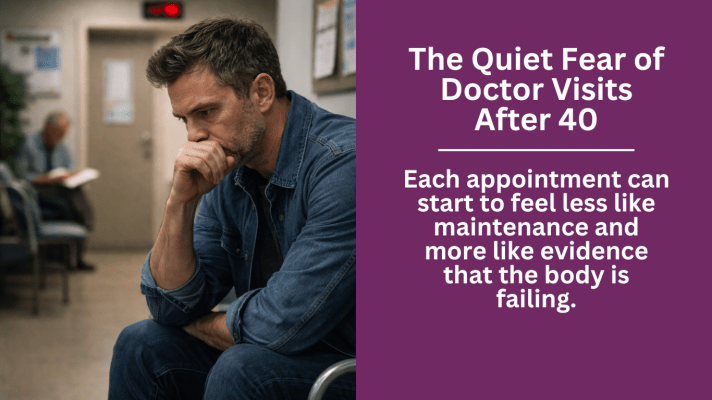
The Quiet Fear of Doctor Visits After 40
Oh my god, does aging suck. It reminds us that life can, and will, take away things we once took for granted. It can feel like we lose more than we gain, and that there’s little hope of fixing what’s changing. So it’s no surprise that doctor visits amplify that fear.
As we age, medical appointments become routine. Checkups increase. New concerns appear without warning. That alone can create enough anxiety to derail your day. Then comes the mental spiral: self-diagnosis, worst-case scenarios, and the quiet assumption that bad news is inevitable. Each appointment can start to feel less like maintenance and more like evidence that the body is failing. And that’s for those who believe they’re healthy. Add a prior diagnosis, and the fear intensifies. What will they tell me is wrong next?
For queer men, this fear often comes layered. Do you disclose your sexuality? Your relationships? Can you speak freely without worrying about stereotypes or dismissal? Or worse, do you encounter a provider unwilling to engage with your specific concerns? Speaking as a queer man with a preexisting diagnosis who returned to regular doctor visits in December 2020, I understand how heavy this can feel.

When Being a “Good Patient” Undermines Your Health
I was raised by a father who didn’t believe in going to the doctor. If I got hurt, his response, like many Boomers raising Gen X kids, was to brush it off and move on. That mindset created distance between me and healthcare. Add to that the fact that many of my early medical visits involved severe allergy reactions, and it’s no surprise I avoided doctors for much of my adult life.
For many people, doctor visits are something to endure and get through as quickly as possible. That mindset makes it easy to leave concerns unspoken, whether it’s fear of being dismissed because of age, sexuality, or inconclusive test results. We file worries away for later, often convincing ourselves they aren’t important enough to mention. Unfortunately, delaying conversations or minimizing symptoms can limit treatment options and clarity.
As queer men, we may be even more cautious about sharing personal details out of fear of judgment. And when we do open up, we sometimes rush explanations, leaving out information that could matter. This isn’t exclusive to queer men, many men struggle with it. There’s an unspoken belief that virility equals health and manhood. But avoiding honest conversation doesn’t protect us. It isolates us.
Letting go of the “good patient” role doesn’t mean being confrontational. It means being honest.

Advocating for Your Health vs. Trying to Control Outcomes
For many of us, especially after 40, advocating for yourself at the doctor can feel uncomfortably close to control. When the body becomes less predictable, the instinct to manage every variable makes sense. We research relentlessly, track symptoms, memorize lab ranges, and rehearse questions as if preparation alone can eliminate uncertainty. But control is about trying to remove uncertainty, while advocacy is about learning how to move through it. Advocacy doesn’t require mastery of medicine or perfect understanding, it requires presence.
The shift happens when the goal stops being certainty and starts being clarity. Advocating for yourself doesn’t mean challenging every recommendation or arriving armed with internet diagnoses. It means asking questions when something doesn’t make sense, naming concerns that feel easy to dismiss, and requesting time when decisions feel rushed. Advocacy is collaborative by nature, it recognizes that doctors bring expertise and patients bring lived experience. When you stop trying to control outcomes and start participating in the process, care becomes something you’re part of, not something that happens to you.

Learning to Speak Clearly at Doctor Visits When Fear is Loud
Before December 2020, I hadn’t gone to a doctor for a routine visit since high school. Most of my medical interactions involved emergency allergy reactions or work injuries. So when I scheduled an appointment for December 24, 2020, fear dominated my thoughts. I knew something felt off, and my mind raced through every possible outcome. I tried to be open during that first appointment, but I could feel myself shutting down.
From that visit through my cirrhosis diagnosis, many appointments involved me sitting quietly while information was delivered. Once the shock faded, I realized that if I wanted to live a full life, I needed to engage differently. I began researching, writing questions down, and forcing myself to ask them, even the uncomfortable ones. Education required conversations I would have rather avoided, but avoiding them wasn’t an option.
Sometimes you have to swallow your pride and move forward, even if you choke on it.

Choosing Presence Over Avoidance in Midlife Healthcare
Avoidance often masquerades as self-protection. We delay appointments, postpone tests, and ignore follow-up calls, telling ourselves we’ll deal with it later. In the short term, not knowing can feel calmer than knowing. But over time, avoidance narrows life. It quietly hands decisions over to fear and replaces agency with waiting. Presence doesn’t promise comfort, it offers honesty.
Choosing presence doesn’t mean pretending fear disappears. It means deciding that fear doesn’t get the final say. It looks like showing up even when your stomach tightens, asking the question even when your voice wavers, and staying engaged when answers aren’t complete. Over time, presence becomes its own form of stability, not because outcomes are guaranteed, but because you’re no longer disappearing from your own care.

Advocating for Long-Term Health After 40
Many of us grow up believing doctors know everything and will automatically tell us what we need. There’s truth in that, but also limitation. Doctors can only work with what they’re given. When we hold back concerns, minimize symptoms, or rush through explanations, care becomes less precise.
This isn’t a call to be fearless or perfect. It’s simply an acknowledgment of where many of us find ourselves. Doctor visits after 40 still bring fear. New information still unsettles me. But over time, I’ve learned that staying present, asking, sharing, returning, matters more than feeling confident. Long-term health isn’t built on certainty. It’s built on continued participation, even when things feel uncomfortable.
Thank you to everyone who visits GayintheCLE.com and spends time with these reflections. Sharing them feels like talking with family, and I’m grateful you’re here.


 Gay in the CLE