
Letting Go of the Fantasy of Getting Back to Normal
Chronic illness in midlife often poses its own unique set of challenges. Our bodies don’t recover quite as quickly as they used to, we start to lose many of the defenses our bodies once had to prevent illness, and there is far less support for dealing with health issues than there was when we were younger. This became glaringly noticeable after I was diagnosed with cirrhosis in April of 2021. That was hard news to swallow and, admittedly, I went through some very dark thoughts before finally deciding to start fighting. I developed the mindset that I could beat this disease—that I could get back to being “normal,” to how things were before my diagnosis. As each new test result came in and each new complexity of the disease was revealed with stunning clarity, I began to realize that there was no going back. I needed to find a different way of looking at my situation.
It was at this juncture that I came to the realization that I have a relationship with cirrhosis, and as such, it needed to be treated that way…
Did that surprise you? Good, because many of the things we deal with in life are exactly that: relationships—with ourselves. I began learning that what I needed to strive for was stability with this disease. I had to absolve myself of the belief that stability meant a cure, because a cure only comes at the cost of a transplant. I needed to reshape the idea that stability doesn’t mean stagnation. How I approach this disease can change almost daily, and I need to be able to adapt to whatever may happen. And lastly, stability is an ongoing relationship, much like dating or being married. You’re presented with a new situation involving yourself and another party, and you have to learn how to navigate it, adapt to change, and discover what nourishes that relationship.
Join me as we talk about Living With a Chronic Condition in Midlife: What Stability Really Looks Like.
- Letting Go of the Fantasy of Getting Back to Normal
- What We’re Taught to Believe About Health (And Why It Fails Us)
- Chronic Doesn’t Mean Constant Crisis
- Redefining Stability in Midlife
- Living Inside a Body That Requires Ongoing Attention
- Living Forward Without Waiting to be “Fixed”

What We’re Taught to Believe About Health (And Why It Fails Us)
From an early age, we’re taught to think about health as something you earn. If you eat the right foods, follow the right routines, and show enough discipline, your body is supposed to cooperate. Illness, in this framework, becomes a personal failure—a sign that you didn’t try hard enough or didn’t do things correctly. This way of thinking is especially damaging as we age, because it leaves no room for bodies that change, conditions that persist, or realities that don’t resolve on a neat timeline. When health is treated like a moral achievement instead of a living relationship, anyone whose body requires ongoing care is set up to feel like they’ve done something wrong simply by existing.
Somewhere along the way, I came to think about health the way you advance a character in a video game—the more experience you gain, the stronger you become. There’s a small grain of truth in that: the decisions you make can affect your health, just as choices affect a character’s progress. But that mindset doesn’t serve us well when dealing with health after 40. As we age, our bodies, needs, and abilities change. We have to learn to adapt if we hope to thrive. That means letting go of the idea that illness is always a failure or a lack of discipline. Sometimes, it’s simply how the cookie crumbles, and we’re left to put the pieces back together.
As queer men, we also have to recognize that our aging bodies often require constant care—and care that can look very different from that of our heterosexual counterparts. Many of us feel alone in our health journeys, which leads us to keep chronic conditions invisible to the world, and often even to ourselves.
We’re taught to chase health like a finish line rather than live it like a practice. A practice requires daily attention. It means adapting to illness, whether chronic or temporary. It means advocating for our well-being as fiercely as we advocate for our place in the world. It means being seen and heard by our doctors. That is what treating health as a practice truly means.

Chronic Doesn’t Mean Constant Crisis
“Your results have come back, and there are signs that indicate you have cirrhosis,” the doctor said as I stood in line at the pharmacy picking up a prescription they had given me just hours earlier. For a brief moment, the world stopped. My vision darkened at the edges, and I felt like everything had ended. I had grown up seeing what cirrhosis could do to a person and the kinds of people it was often associated with. I was in disbelief. There was no way it could be me—I wasn’t an alcoholic, I didn’t spend my time in bars, and I wasn’t a drug user. Those were the images I had attached to cirrhosis: a disease that kills you because you made bad choices. To me, chronic meant death. I had a lot to learn.
Simply put, chronic means ongoing, not curable. Arthritis is a good example—it causes recurring pain and swelling and has no cure. The best you can do is manage symptoms and try to prevent progression. These become your new operating orders.
All of this can cause enormous anxiety, which in itself can feel like another chronic condition. I spend a lot of time thinking about what I eat, take, or do and how it may affect my disease. I worry that changing one element—diet, exercise, routine—could suddenly make things worse or undo years of progress. All of this while maintaining the appearance of being “fine.” If I don’t appear fine, I worry people will see me as complaining or seeking sympathy. It’s exhausting.
Over time, I’ve learned that chronic doesn’t mean death—it means ongoing, like treatment. Some days are good: I exercise, eat well, manage my weight, and feel capable. Other days are quieter. Some days I’m more tired than usual and need to allow myself to do nothing at all. The constant worry doesn’t give me any advantage over simply continuing what I know works. Energy fluctuates. Some days you can’t do everything you normally do—and that’s okay. It’s just as valid as staying on course.
Not every doctor visit will be perfect. Your condition will change. Stressing over following every rule perfectly won’t fix biology. We aren’t machines—we can’t replace parts on demand. You can follow every recommendation and still face uncertainty. You can ignore everything and live a long life. Biology doesn’t operate on moral rules. You will change, and your plans must change with you. Give yourself space to respond to what is—and space to enjoy life, too.
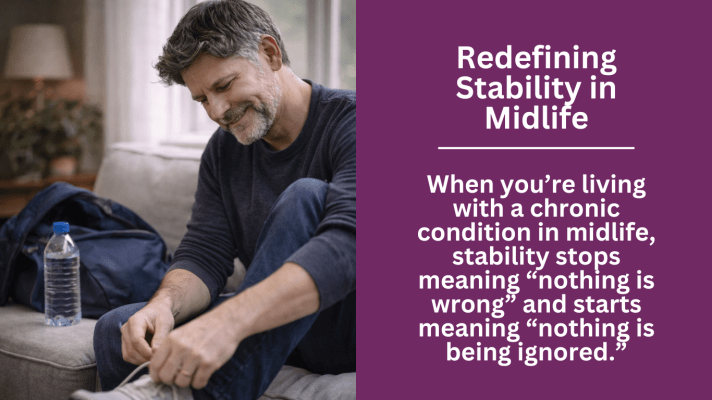
Redefining Stability in Midlife
When you’re living with a chronic condition in midlife, stability stops meaning “nothing is wrong” and starts meaning “nothing is being ignored.” Chronic illness in midlife doesn’t ask for perfection—it asks for attention, flexibility, and honesty. Stability isn’t the absence of symptoms or a return to a former version of health. It’s knowing what your body can handle today and responding with care instead of panic. Managing chronic illness after 40 becomes less about control and more about relationship—an ongoing practice of noticing, adjusting, and staying engaged.
What makes this difficult is that we’re rarely taught to value steadiness. Health after 40 is often framed as a battle against decline, where success means appearing unchanged. Redefining health means letting go of that binary. Stability can look like predictability instead of progress, sustainability instead of intensity. It means building routines that bend rather than break and trusting that living well with a chronic condition is not a compromise—it’s a skill.
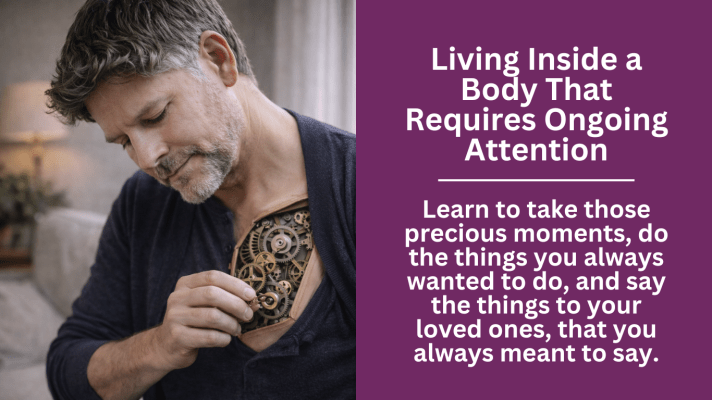
Living Inside a Body That Requires Ongoing Attention
This April will mark five years since my initial diagnosis with Cirrhosis. Everyday I learn something new about this disease and how it relates to my body. Every month there is a new doctor I meet or a new test I have to do. I watch the amount of water, sodium, sugar, and other items, daily. I have to adapt my workout routines to meet the needs of my body as it changes. Then there is all of the bloodwork I take every three to six months, scans, and procedures so that the doctors know what my health is like. Every one of those takes its toll on you, over time.
I need to eat enough to keep my body fueled for the day without eating too much. That turns to fat and then gets stored around organs and under the skin, all of which is bad for cirrhosis. I have to work out to keep muscle tone up and weight off but have to balance that with the correct amount of calories to offset the energy expenditure. And then there is the issue with getting enough rest, whether that simply means sleep or much deeded downtime. Each of them is like a meeting with a bunch of people who all demand things but fail to realize how their needs are interdependent on the rest of the system.
Dont get me wrong, there have been amazing benefits from all of this focus. I am in some of the physical shape that I have ever been in. At the end of last year, I was running fifteen miles a week. Finding out I had cirrhosis allowed me to incorporate health and wellbeing into my daily life. I put my health and the number one priority to all other things, that includes mental, as well as physical health.
If I can share a few lessons I have and am still learning, it would be these:
This April marks five years since my diagnosis with cirrhosis. Every day I learn something new about how this disease interacts with my body. There are new doctors, new tests, new scans. I monitor water, sodium, sugar, and other factors daily. I adapt my workouts. I undergo regular bloodwork and procedures. Each one takes a toll over time.
Balancing food, movement, rest, and energy feels like managing competing demands that don’t always acknowledge their interdependence. And yet, there have been benefits. I’m in some of the best physical shape of my life. At the end of last year, I was running fifteen miles a week. This diagnosis forced me to prioritize my health—mental and physical—above everything else.
Lessons I’m still learning:
- Rest is as important as action.
- Attention isn’t obsession.
- Care is not fear.
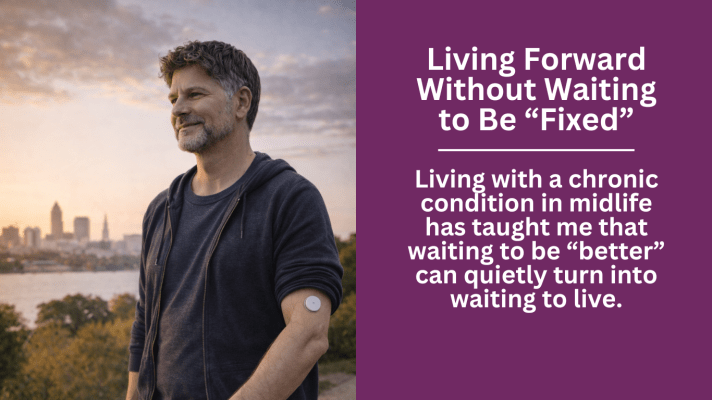
Living Forward Without Waiting to be “Fixed”
Living with a chronic condition in midlife has taught me that waiting to be “better” can quietly become waiting to live. Health after 40 doesn’t operate on neat timelines. Stability isn’t a destination—it’s a practice. Managing health in midlife means living with uncertainty instead of postponing your life until it disappears.
Change is constant. Labs change. Plans change. Bodies change. Learning to adapt—to roll with what comes—is the truest form of stability I know.
What lessons has your health taught you in your 40s and beyond? What chronic condition changed your life, and how did you adapt? Let me know in the comments. Thank you for being part of the GayintheCLE community and for allowing me to share these windows into my life. I hope what I share helps you feel a little less alone.


 Gay in the CLE