
Winter as a Truth-Teller
I know I am not alone in saying, Winter changes how my body moves through this world.
At 52 years of age, I feel it in the mornings more than any other time. The extra stiffness getting out of bed, my joints staying stiffer longer, and the conversation I have with my inner self about what I have planned for the day and what it think it has energy to accomplish.
It can be a struggle.
Winter has a way of stripping things down to what’s real. Nature doesn’t pretend during this season. Trees don’t apologize for going bare. Animals don’t force growth that isn’t sustainable. Everything slows because it has to — not because it’s failing.
And yet, for many of us, especially queer men in midlife, slowing down triggers something else entirely. It feels suspicious. Dangerous, even. Like the first step toward disappearing. For me, I internalize it harder, just ask Karl he is always telling me to relax and try to see it differently. I start using a treadmill instead of running outside and that in turn lowers my caloric burn. With the winter season, eating also increases due to the holidays. As a result, I have put on weight and often left feeling that I will end up back at the dreaded 300 points I was at in 2020. It is scary.
We’ve been taught, explicitly and implicitly, that momentum equals worth. That staying active means staying relevant. That rest is something you earn only after exhaustion, or worse, something you justify when your body finally breaks down enough to demand it. Slowing down can feel like a betrayal of everything we were told would keep us visible, desirable, and safe.
Our bodies change with the seasons, as much as it affects our world. Join me today as we look at Winter Bodies: Slowing Down Without Giving Up on Yourself.
- Winter as a Truth-Teller
- Slowing down equals giving up
- What winter does the to body (especially after 40)
- Slowing Down vs. Stopping: The Distinction That Matters
- Learning to listen to a winter body
- Rest without guilt (why this is so hard for us)
- Staying in relationship with yourself through this season
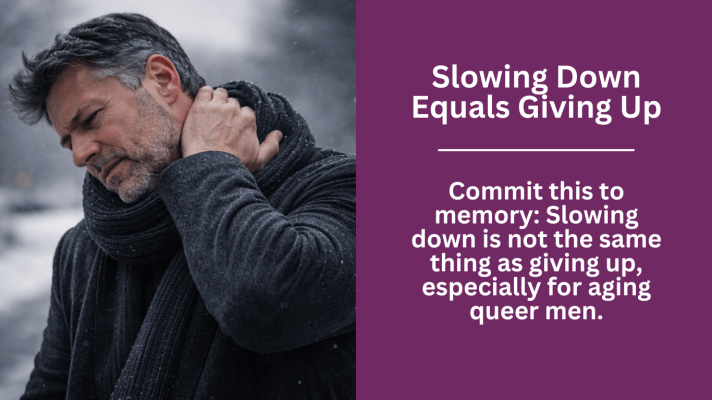
Slowing down equals giving up
There is a myth that culture has forced into our operating systems that Slowing Down Equals Giving Up. We are told we are lazy if we do not push ourselves to the levels others dictate are the way we need to act and interact with our surroundings. But it is just that, a myth.
Commit this to memory: Slowing down is not the same thing as giving up, especially for aging queer men.
Giving up means that you stop caring, stop engaging, or stop believing there is anything left to be done. It is not the same as slowing down. Slowing down is adjusting to circumstances or events at the time they are relevant. It is more akin to a recalibration to real, ever changing conditions. It is not a retreat, it is giving those details the needed attention it deserves.
What makes this hard is that many of us were never taught how to adapt without shame. We learned how to push, how to endure, how to outperform fear. Those skills kept us alive in younger years. But they don’t always serve us well now, especially in winter, when the body’s signals grow louder and harder to ignore.
Slowing down isn’t quitting on yourself. It’s staying in relationship with your body as it changes. It’s choosing care over performance. And for many of us, that choice feels unfamiliar enough to be mistaken for failure.
“We weren’t taught how to slow down—we were taught how to disappear.”
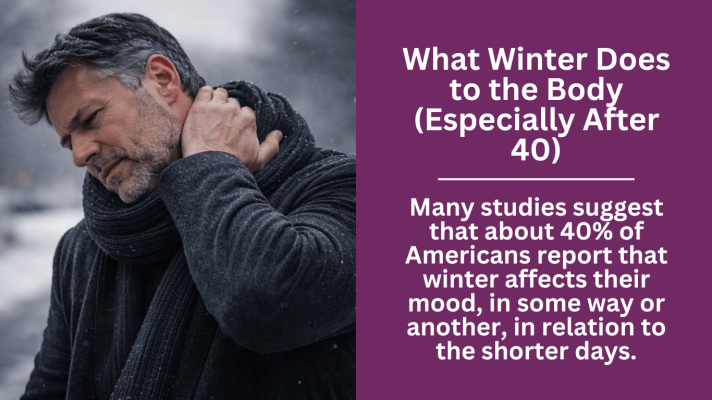
What winter does the to body (especially after 40)
Winter changes how the body feels from the inside out, especially as we get older. Energy no longer shows up on demand; it arrives more slowly, more selectively, and often with conditions attached. Recovery takes longer than it used to, stiffness lingers in the cold, and mornings require a kind of patience we didn’t need before. Joints speak up sooner, fatigue feels heavier, and the body seems less interested in being pushed past its limits. None of this means something is wrong. It means the body is responding honestly to season, age, and the accumulated weight of living. Winter doesn’t weaken the body—it reveals the pace it was always meant to keep.
One factor that hits us really hard, and many dont often think about, is Season Affective Disorder (SAD). Many studies suggest that about 40% of Americans report that winter affects their mood, in some way or another, in relation to the shorter days. Reduced sunlight often disrupted our circadian rhythms, lowers serotonin, and reduced Vitamin D and these cause us to feel more fatigue, experience bouts of sadness, increased appetite, and, as mentioned, issues with sleep.
All of this adds up and leaves us feeling down on our bodies and ourselves.
This often causes our bodies to produce less serotonin and our workouts often to slow, as well This causes us to lose that “feel good” feeling we get when we are working out regularly. For me, I tend to panic because I cant get outside to run as often, due to reduced daylight and the cold causing my joints to feel more stiff. Arthritis is a pain in the ass.
I keep trying to learn to be a bit more gentle to myself, during this time of year. Just know that this is due to weather and changes to our routine and not actually something we are doing. We need to learn to give ourselves permission to slow down, to rest a little more, and not be as hard on ourselves when we cant do the things we need to do.
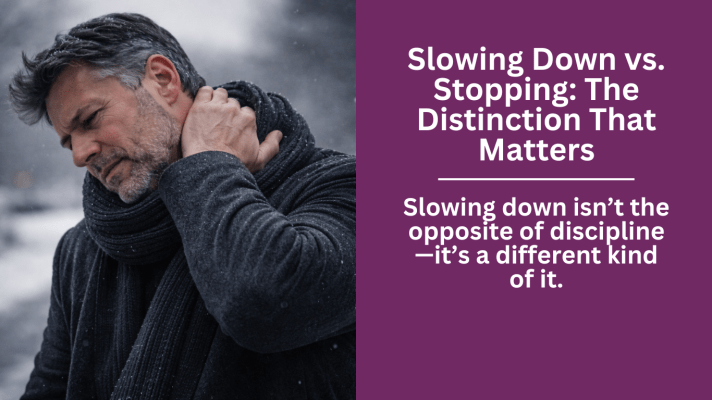
Slowing Down vs. Stopping: The Distinction That Matters
We often forget how amazing the human body is in all of its complexities. It is because of this complexity that we need periods of slowing down to allow our bodies to repair and adjust. But, we are taught and see daily that being slow or resting is the same as being lazy and we are guilted into that belief and then take it out on ourselves when we aren’t doing what others tell us we should be.
I work on this thought process daily, slowing down is not the same as stopping. I will admit that I fail at believing this even though I know its truth.
I know that my body changes as the year progresses, as sunlight wanes, so does the amount of energy my body produces. Calories I eat are slower to burn and the drive to be as active as I am during the rest of year also decreases. While my mind understands the science behind these things, it is that dark voice inside my head that taunts me over this.
It is during this darker time that I feel like I have given up on myself. The truth is just that I need a little more motivation to get started and learn that it is okay to be a little slower, that it doesnt mean I have given up.
Slowing down isn’t the opposite of discipline—it’s a different kind of it.
Learning to listen to a winter body
Listening to a winter body isn’t about fixing anything. It’s about paying attention without immediately trying to override what you hear. For me that is hard. If I am seeing an issue, my first thought is to respond to them. Most times, without giving them the proper thought and time they need.
For a long time, I treated my body’s signals as obstacles to push through. Fatigue meant I wasn’t trying hard enough. Stiffness meant I needed to do more, not less. Wanting rest felt like weakness, or worse, a kind of personal failure. Those responses weren’t accidental—they were learned. Many of us were taught to survive by ignoring discomfort, by proving we could keep going no matter what. When adding cirrhosis to that, I adopted the idea that I need to push myself so I could beat this disease. What I needed to do was learn to listen, more.
Winter doesn’t respond well to that approach.
A winter body speaks more quietly, but more persistently. It asks for pauses instead of momentum, warmth instead of intensity, recovery instead of repetition. Learning to listen means noticing when energy starts to thin instead of waiting until it’s gone. It means recognizing the difference between discomfort that passes and strain that accumulates. It means choosing to stop before you have to be forced to stop.
This kind of listening can feel unfamiliar, even unsettling. It requires letting go of comparison—especially to younger versions of ourselves who moved faster and recovered more easily. It also requires trusting that staying in tune with your body isn’t the same as giving in to it. Attention is not indulgence. It’s how continuity is preserved.
What I’m learning, slowly, is that listening doesn’t make life smaller. It makes it more sustainable. When I respond to what my body is asking for instead of what I think I should be capable of, I don’t disappear—I stay present. Winter teaches this lesson quietly, over and over, until we stop mistaking care for retreat and start recognizing it as a form of respect.
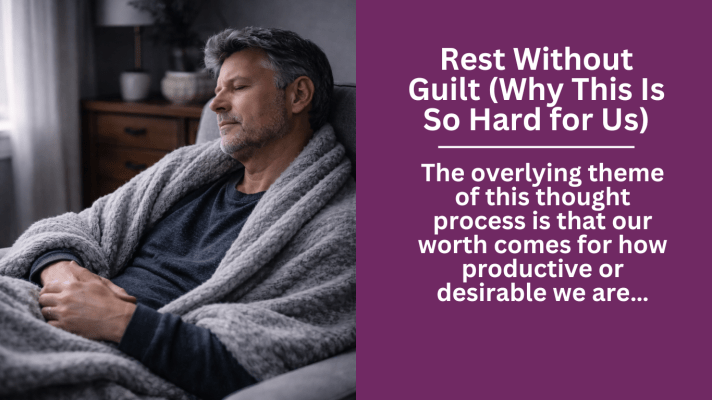
Rest without guilt (why this is so hard for us)
There is a saying that, for whatever reason, still sticks with me : ” You can sleep when you are dead.”
This one sentence forces us to learn that we are allowed to rest when we have pushed ourselves to our limits of breaking. We feel that if we put in the “honest day’s work” we are rewarded with the rest we need. This is a larger belief held by queer people in general. We are told over and over that our fight isnt over until we have the same freedoms, lives, and safety that everyone else in this world has. That we have to keep fighting for, not only our survival, but the trivial things that many others take for granted. The overlying theme of this thought process is that our worth comes for how productive or desirable we are and those things can only be achieved by hard work and sacrifice.
What we don’t learn is that rest is far more advantageous for us, than the constant hyper-vigilance we live with.
Rest is much more than a recovery process we have to endure. When we take the time to rest and recover, our mind catches up with the world and our bodies. It allows us the clarity of thought to see things more objectively, instead of reactionary. Having more energy allows our thoughts to be less muddied and we interact with others better.
The thing we need to learn is that it is okay to choose stillness, choose that one of recovery over action, and to just slow down. If we dont allow ourselves that time, our bodies may force us to take it and that could have far reaching implications to our long-term health and wellness.
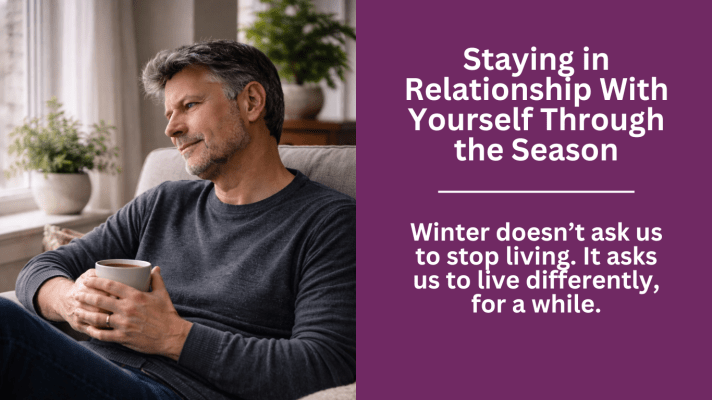
Staying in relationship with yourself through this season
Winter doesn’t ask us to stop living. It asks us to live differently, for a while.
I’m still learning how to do that without panic. Still learning how to trust that slowing down isn’t the beginning of the end, but a way of staying in relationship with myself when my body needs something other than what I’m used to giving it. Some days I listen well. Other days I argue with myself, push harder than I should, or let fear do the talking. None of that makes me a failure. It makes me human.
What winter keeps showing me is that care doesn’t always look like progress. Sometimes it looks like restraint. Sometimes it looks like choosing warmth over intensity, patience over pressure, and presence over performance. These choices don’t mean I’ve given up on myself. They mean I’m still here, paying attention, willing to adjust rather than disappear.
Aging doesn’t require us to prove anything. It asks us to stay honest. To stay curious. To stay kind to the bodies that have carried us this far. Winter will pass, as it always does. Until then, I’m learning that slowing down isn’t something to fear—it’s a way of staying with myself through the season, instead of leaving when things get hard.
What are your thoughts on giving yourself permission to slow down? Do you struggle with some of the same issues I have or mentioned? How do you handle this delicate balance? Let me know your thoughts in the comments, below. Thank you for being a part of GayintheCLE and making this blog happen. Without each of you, I would be sitting here sharing my life, thoughts, and such with you. I really appreciate all fo you.


 Gay in the CLE