
As I write this, I am sitting in my study on New Year’s Eve 2025. It somehow seems almost appropriate to discuss aging at this time of year, as the New Year is upon me. Winter is an odd season, for many reasons, but for nature it is a period of rest and a time of preparing for what is to come. Those cycles are as old as time itself, but it often seems that Queer Men weren’t given a manual on how aging would look like for us. Instead, we have been shown the hyperfocus on youth. The movies (whether it be porn or some rom com) to the magazines that grace our living room tables are filled with displays of youth and the focus on its importance. Page after page filled with some concoction that claims to keep our youth and vigor while keeping us desirable to our potential partners. And now a warning… Those trappings are just that, trappings. We have simply forgotten how to age with dignity, integrity and respect.
Today, I wanted to discuss this very topic, especially since it is feelings I seem to revisit often. Join me as we look into What No One Tells Queer Me About Aging (Until it is Already Happening.)As I write this, I am sitting in my study on New Year’s Eve 2025. It somehow seems almost appropriate to discuss aging at this time of year, as the New Year is upon me. Winter is an odd season, for many reasons, but for nature it is a period of rest and a time of preparing for what is to come. Those cycles are as old as time itself, but it often seems that Queer Men weren’t given a manual on how aging would look like for us. Instead, we have been shown the hyperfocus on youth. The movies (whether it be porn or some rom com) to the magazines that grace our living room tables are filled with displays of youth and the focus on its importance. Page after page filled with some concoction that claims to keep our youth and vigor while keeping us desirable to our potential partners. And now a warning… Those trappings are just that, trappings. We have simply forgotten how to age with dignity, integrity and respect.
Today, I wanted to discuss this very topic, especially since it is feelings I seem to revisit often. Join me as we look into What No One Tells Queer Me About Aging (Until it is Already Happening.)
- The Myth of perpetual youth
- Bodies that change and the shame we inherit
- Invisibility vs. freedom
- Midlife as emotional literacy, not crisis
- Why aging with integrity is a choice
- An invitations, not a conclusion
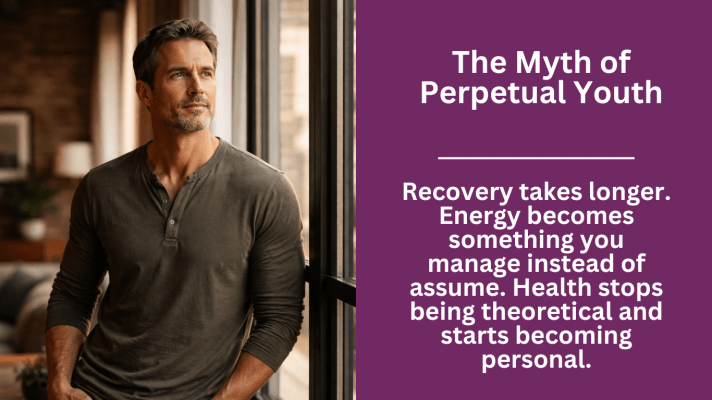
The Myth of perpetual youth
No one tells gay men what aging actually feels like.
We’re given images instead, either the fantasy of eternal youth or the cautionary tale of invisibility. Stay fit. Stay relevant. Stay desirable. Don’t slow down. Don’t let yourself go. Don’t disappear.
What no one prepares you for is the quieter truth: aging doesn’t arrive as a collapse. It arrives as a series of recalibrations; physical, emotional, relational, that force you to renegotiate who you are when the rules you learned no longer apply.
Your body changes first. Not dramatically, not all at once. It simply begins asking different questions of you. Recovery takes longer. Energy becomes something you manage instead of assume. Health stops being theoretical and starts becoming personal.
Then comes the emotional shift. The realization that being wanted isn’t the same as being known. That chemistry doesn’t equal safety. That loneliness can exist even in full rooms — especially the rooms you once felt centered in.
Aging, for many gay men, isn’t about decline.
It’s about losing the scripts we relied on and not being handed new ones.
And that’s where the real work begins.
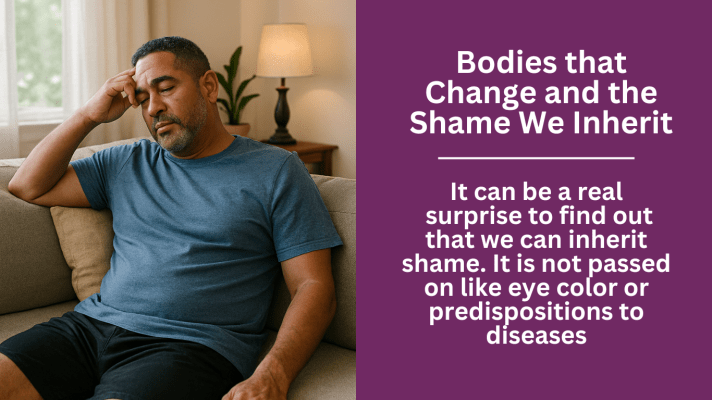
Bodies that change and the shame we inherit
It can be a real surprise to find out that we can inherit shame. It is not passed on like eye color or predispositions to diseases, instead it is the shared psychological and social phenomena that are passed on or inherited.
Most of us, if we were out at an early age, often develop a sense of inadequacy and alienation from our young lives due to the negativity we often get from our peers, family, and society. We often internalize distorted beliefs about our self worth based on anti-queer rhetoric from society, religion, or our government. As such we often don’t have the expansive support system that is available to the rest of society. And then there is the shame we often receive from our own community about our age and the worth it brings.
This becomes even harder to deal with when we watch out bodies change as we age. I am in my early fifties and I see my body change each year in ways I wasn’t ready for, my eyesight slowly get worse each year, visits to the doctor bring up another point of concern, and then there is just my body aging and showing it. It is frustrating.
The sad part of all of this is that there is little concern in changing the way things are currently happening. There are very few or no media outlets that show older LGBTQ+ people in active and fun lifestyles. Talking to medical professionals, whether psychologists or your primary care physician, seems to focus on correcting what we feel instead of what makes us feel that way. We need to learn how to have the same fun and perspectives we did when we were thirty years younger. We need to realize that aging does not mean we cannot be the vibrant Queer people we were in our youths, we only need to find that spark again. To learn to be free!
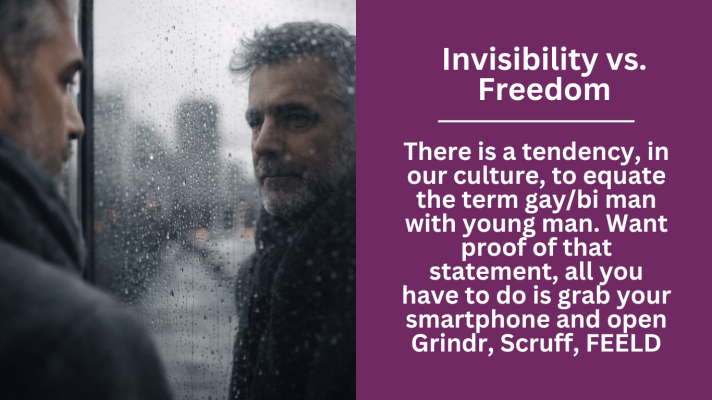
Invisibility vs. freedom
There is a tendency, in our culture, to equate the term gay/bi man with young man. Want proof of that statement, all you have to do is grab your smartphone and open Grindr, Scruff, FEELD, or any other app and you will see more profiles of younger men being promoted than you will see older gay men. This stems from a place where the term elderly man is seen as a heterosexual man. Again, look no further than the media for that. Almost any TV show has an older heterosexual male that people often go to for advice or see as someone with knowledge and importance. Thus, leaving older queer men to become invisible on the sidelines.
So, what about Freedom? Well like all freedom, it must be earned and comes at a price. For us older queer men, we have already earned it with us aging. We just havent opened ourselves up to accepting it.
Five years ago I created a change in my life. I changed my eating habits to being vegetarian, I changed my activity habits to exercising five days a week, and I started working on changing my mental perspective by going into therapy. Each of those have been foundational in learning to become free.
WIth the physical activity part, I had to learn to let go of the ideals of youth. As an older man, my body does not have the recovery ability that someone half my age has and nor do I have the musculature or stamina. I had to learn new ways of working out that would allow me to continue to do it safely, for myself and my body. I had to stop focusing on youth. I am not a young guy any longer.
I have also started to learn that aging brings about a type of freedom we can’t see when we are younger. We have had an entire lifetime to become who we are, develop the tastes we have, and have the ability to indulge in them, respectfully. Once we accept that we dont have to be someone else’s idea of who we are, we can truly become who we are meant to be. Admittedly, I am having a bit of a difficult time in learning to “not care” what others think of me, but I am working on it. Age has allowed me to find the style that resonates with me and, in turn, reflect it back to the world I live in.
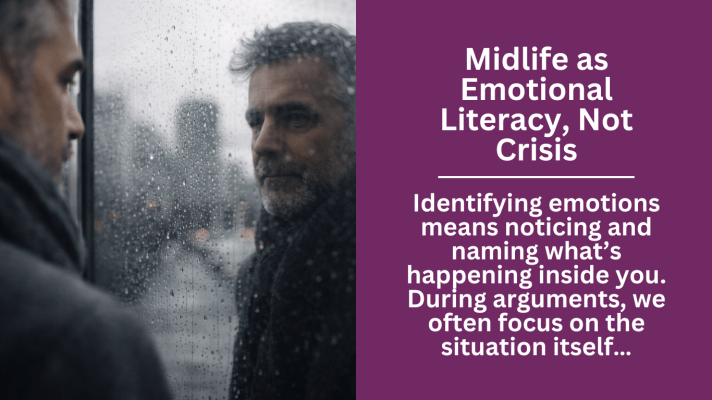
Midlife as emotional literacy, not crisis
I’m not going to lie, writing this is difficult, because this is exactly where I am right now. I’m in the middle of learning emotional literacy. What no one really tells queer men about aging is that getting older often means learning how to properly identify emotions. You’d think we’ve had a lifetime to do this, and in some ways, we have. We know anger, happiness, and grief. What we don’t always learn is how to name what we’re feeling or recognize it in others, which is essential for real communication and growth.
Identifying emotions means noticing and naming what’s happening inside you. This is huge for me. During arguments, we often focus on the situation itself—who did what, who’s right, who’s wrong. We know we’re upset, and we want the other person to feel it too. Those moments rarely end well. Emotions escalate, and we get in our own way. Slowing down and understanding how you arrived at a feeling is far more productive. Saying, “I feel frustrated when…” opens communication in ways arguing never does. But to get there, you have to understand what triggers your emotions and how they shape your thoughts and behaviors.
For me, certain phrases or tones can pull me straight back into old trauma. When that happens, I become defensive and shut down as a way to protect myself. To my partner, it can sound like I’m making excuses or avoiding the issue, which only adds to my frustration. Taking a moment to notice what’s being triggered, while you’re in it, can be uncomfortable, but it’s necessary. You can’t fix what you don’t understand.
Then there’s learning how to express, manage, and show empathy—both to others and ourselves. We carry a lifetime of trauma, and working through it isn’t easy. Expressing emotions in healthier ways means learning to communicate without just reacting. Exploding when you’re hurt or bottling everything up both lead to bigger problems. We can’t control what others say or do, but we can control how we respond. That’s emotional management. What I’m working on now is deciding whether engaging with a situation is worth the stress it brings—or if I can step back and see how I feel later. When we’re hurt or angry, we often want the other person to feel it too, but that isn’t healthy or productive. We have to learn better ways to handle what life throws at us.
All of this requires empathy, understanding where someone else is coming from and recognizing whether the moment is right to engage or if waiting might lead to a better outcome.
The hardest part, though, is learning to do all of this for ourselves. We are, after all, far harsher with ourselves than we ever are with anyone else.
Why aging with integrity is a choice
I think having choices is an amazing thing. We live a life where we can go after almost anything we want and get it, if we choose to. Nowhere is this more important than in aging.
Growing up, I never thought about growing old because when I saw older people around me I only saw their diminished capacities, lack of drive, and basically being forgotten be everyone else. I was scared of that outcome, I did not want it. What I didnt know, at the time, was that how you choose to age is just that… a choice! You can either be actively involved in choosing things or you can choose to sit there and let everything else happen.
Choosing to age with integrity starts with looking back over your life and seeing how meaningful it was, that successes and failures are equally important for growth, and that death is a natural part of life and not something to fear. Personally, I fully believe that a fear of death is more a fear of not getting to do or complete the things you wanted to, before you left this world. Essentially, it is stressing over missed opportunities you believe you could have had or thinking your life was a waste of unfruitful conditions that just happened to you.
The good news is that it is never too late to change that mindset.
Choice is amazing, it allows you to see that you are the one responsible for how you react to the world, not other things or people. It also allows you the opportunity to choose to live your life with integrity over fear. It isnt as easy as changing clothes, but here is a short life of how to choose integrity.
- Self reflection and acceptance – being able to reflect on your life’s journey and accept it for what it is, both good and bad, as just being a part of your multi-faceted story.
- Making amends – Life happens and it is not always good. It is up to us, where possible and appropriate, to seek to correct the wrong doings we have have done and work to actively apologize to people we have harmed and to work to resolve any lingering regret we may have.
- Continued interactions – Just because you are older doesnt mean that you cannot be a part of all the options the world has to offer. Strive to find purpose in your life and engage when and where you can. It doesnt matter if that is volunteering or exploring new interests. Just keep active.
- Nurturing Relationship – You can go everywhere you want and do everything you ever dreamed of but it is not enough to keep you happy and grounded. This is where we, as humans, need relationships. By staying connected with people, family and friends, we reduce our feelings of isolation and feeling worthless. It helps create a sense of belonging, a community. And in turn, it helps us process some of the negativity we struggle with and creates a sense of belonging and safety.
An invitations, not a conclusion
I don’t have a neat ending for this, because aging doesn’t offer one. It keeps unfolding, quietly and unevenly, asking different things of us at different moments. What I’m learning, slowly, is that we don’t need to conquer this stage of life or rebrand ourselves to survive it. We don’t need to pretend we’re untouched by time, or ashamed of what it’s given us. Maybe the invitation here is simply this: to stop treating aging as something we have to endure alone or fix in private. To allow ourselves to age out loud, with honesty, curiosity, and a little more kindness than we were taught to give ourselves. Not as an ending, but as a continuation—one that still belongs to us.
Remember that life is a contact sport, you have to be engaged in it fully to get what you want out of it. Hopefully, some of the words I have written here will help you move along in your journey. If you found anything helpful or think of better ways to approach them, let me know in the comments section. After all GayintheCLE is here for you and because of each of you. Thank you for allowing me to be a part of your amazing journeys.


 Gay in the CLE