
There is no denying that Southern mountain folk are just raised differently. It often seems like we are caught in a different time, just slightly out of step with the rest of the world. It is a place where myth meets real life to create an environment rich in culture and stories. It is an ancient land that has seen the shaping of the world, the day that humanity emerged on the continent of North America, and even witnessed the forced migration of the people that once called the area home.
For me it was home…
As a child, our grandmothers told us stories of spooks and spectres, many of which were shared to make us behave. Then there were other stories, stories that you could tell touched them differently. As if they had some hidden knowledge of a reality that walks beside us, but, oftentimes, is just out of sight to most. When you grow up in a mountain range that is known to carry an air of mystique and is also enshrouded in a constant blueish haze, you can understand why so many navigate the area with caution and rules… Rules to keep them safe.
Join me as I reflect on some of my childhood upbringing in a post I like to call, Raised Among Haints and Hollow Things.
- The hills have eyes
- “Jesus Christ, you don’t know the rules?”
- Haints, fox fire, and weekend camping
- Respect the unknown
- Don’t leave without leaving something behind
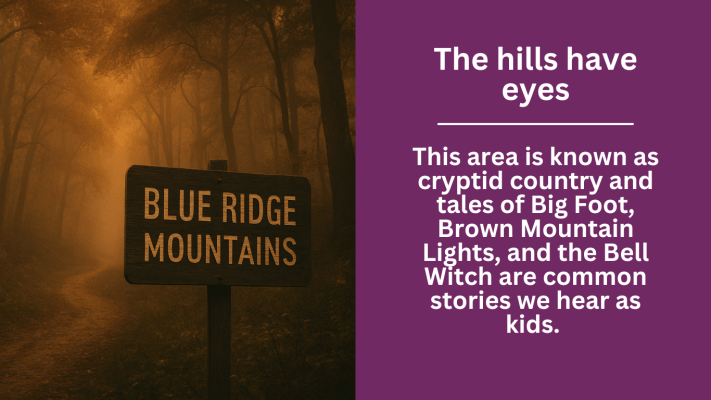
The hills have eyes
I talk about being a southerner, but the truth is that where I grew up is a bit different than just being southern. The area I grew up in is the Virginia section of the Appalachian mountains. Specifically, it is the area known as the Blue Ridge Mountains inside of the George Washington and Jefferson National Forest. This is an area that is steeped in lore and tradition. The truth is that these mountains have been around for a very long time, 480 million years, to be exact. It was one of the first mountain ranges to come out of the sea as those waters receded. To this day, I can still remember scout hikes to the Dragon’s Tooth where we found many polished, round river stones on top of that mountain. Stones that date back to the days when the mountains were still under water.
The folklore is as deep and varied as is the ancestry of the people who inhabit the area. This area is known as cryptid country and tales of Big Foot, Brown Mountain Lights, and the Bell Witch are common stories we hear as kids. In fact, the area I grew up in is known for a few legends. One that my father told me was about spooky lights he saw in an area known as Sandy Flats. He was a young man riding a fence line on his horse and noted these lights that would appear and “dance” or “play” around the area. He never was able to get to them but saw them often.
The other came from my mother. She used to live way out in the country and to get there you had to drive over an area the locals called “the Steep Place.” Oddly, this area received it’s name due to the fact that the main road traveled across the ridge of a small mountain/large hill. On one side of the road was a few hundred foot drop to the river that never had a guard rail or fence blocking it until the mid 1980s. The story goes that in the days of horse drawn carriages, a carriage driver was taking a couple to the next town when he was decapitated by a large tree branch. The resulting loss of his head caused the fatality of the occupants. This spectre was known for running beside cars, still minus a head, in search of where it fell. Sounds all too familiar to another and older legend. Think Sleepy Hollow.
The point I am making here is that paranormal phenomena are normal for us mountain folk. We learn it at an early age, taught to us by our elders, and expected to follow it or suffer the consequences. But, what are these rules, you ask? I am glad you did.
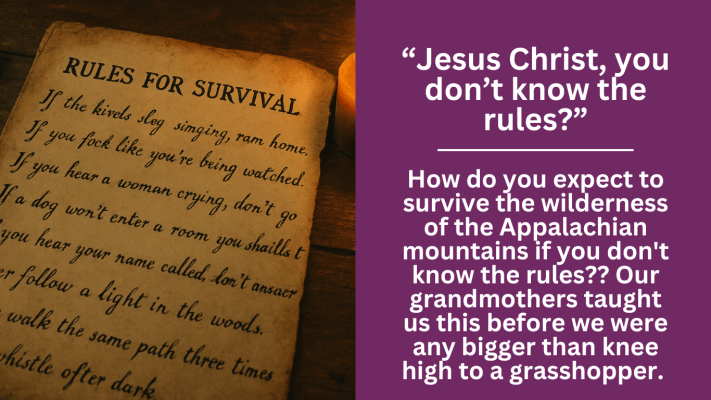
“Jesus Christ, you don’t know the rules?”
Did I hear you correctly that you don’t know the rules? How do you expect to survive the wilderness of the Appalachian mountains if you don’t know the rules?? Our grandmothers taught us this before we were any bigger than knee high to a grasshopper. Well, you are in luck. I am going to share those rules with you, today, since your grandmother did not.
Mountain rules for survival
- If the birds stop singing and the wind dies down, run home.
- If you feel like you’re being watched in the woods, you are.
- If you hear a woman crying in the woods, don’t go looking. If she sounds far away she is close, if she sounds close… run
- If a dog won’t enter a room, you shouldn’t either
- If you hear your name called from the woods and no one is there, don’t answer. It ain’t someone you know
- Never follow a light in the woods—it ain’t trying to help you
- If you walk the same path three nights in a row, something will start waiting for you
- If you hear singing where no one should be singing, don’t answer it—it ain’t meant for your ears
- Never whistle after dark—it calls things that don’t need calling
At first glance, these “rules” seem to evoke terror deep down in your mind. Ever wonder why that is? Humans have an innate distrust for dark places, night, caves, shadow filled woods, and more, the reason is that we don’t see well in the dark and, typically, that is where predators hide. So, it stands to reason to have rules for that type of engagement. “if the birds stop singing and the wind dies down, run home,” is one that can even speak to weather conditions that can turn dangerous in a moment’s notice.
However, these same “rules” also come from other folklore. The Appalachian mountains were settled by a vast array of people, Scottish, Irish, runaway and freed slaves, alike, and Native American (eastern woodland tribes to be specific). Each brought with them their own stories and were easy to translate to an area that seemed familiar to them.
These “rules” were passed around by my grandparents, family members, and even our scout masters—though the latter was more for making us behave while camping. I remember one such teaching from my scout days…
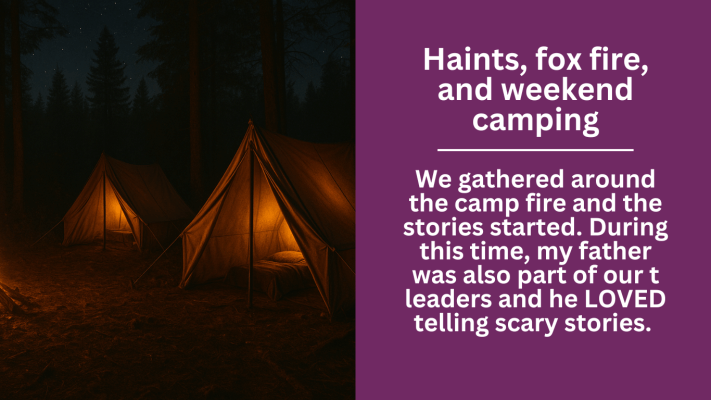
Haints, fox fire, and weekend camping
I became a Cub Scout when I was in grade school and I continued with it until about 1986. We grew up in an area that was steeped in both Native American culture and early American history. There were few places you could go that didn’t have a tie to the Civil War and earlier parts of American history.
One late summer weekend, our troop camped out at our scout master’s house. His house sat on an old family farm and was a perfect place for teaching young scouts about nature, knots, and how to become a man, I guess. The weekend started with us working on a gun safety badge and being taught how to effectively clean, load, and shoot a .22 rifle. Afterwards, we went on a nature hike in the surrounding woods. Our scout master had told us how this area was marked with a lot of unmarked graves from slavery days and the varied battles that had been fought there. On our hike, we even came across an old abandoned house. It was here that fell scout, Derek, found a large leg bone that he decided he had to have. Much to our scout masters dismay. On our way back to camp, we were tasked with collecting firewood so that we could start cooking once back. We gathered small branches to start the fire and some of us carried back logs to be cut up for fuel.
Dinner was well underway and the night was slowly coming. Derek still carried that bone around with him, everywhere. Our scout masters were becoming aggravated because it was hindering him from helping everyone else. We made our foil wrapped dinners and started eating. We started begging out troop leaders to tell us ghost stories once it was fully dark. As always, they agreed.
We gathered around the camp fire and the stories started. During this time, my father was also part of our t leaders and he LOVED telling scary stories. Derek grabbed his leg bone and settled in next to the fire and my dad looked around and asked if we all wanted to be really scared and we all chimed yes.
The story was about an angry Native American chief who was killed by Civil war soldiers. Upon his death bed, he vowed that he would haunt anyone that disturbed his people from their land. Dad took the story one step further by talking about a soldier who thought the curse was funny and dug up his dead body and took his leg as a trophy. The soldier made his way back to camp and, brazenly, showed off his trophy. That night he started hearing moans in the distance but he didn’t think much over it. As the night progressed, those moans got closer. He thought it might be some animal and went to bed in his tent. Slowly, he started hearing sounds outside his tent. “Thump, sss-slide. Thump, sss-slide repeated over and over, slowly getting closer. The soldier’s ears perked up each time. Just then he heard a deep moan just outside of his tent. Suddenly, the tent was grabbed by something and was shaken violently. When the shaking stopped the soldier heard a voice saying, “return what was taken…” The soldier laughed and thought it must be fatigue and tried to go to sleep. “Thump, sss-slide.” The sound was moving towards the door of the tent, the soldier bolted upright in bed, visibly shaken and nervous. “Return…,” he heard a voice from just outside the door. The soldier grabbed the leg tightly, ready to use it as a weapon if he needed to. The door was thrown open and a black shape entered the tent. The soldier fumbled to light a candle. As the light enveloped the tent, what the soldier saw scared him to his very core. He tried to scream out, but nothing came from his throat. The next morning, his fellow soldiers noticed he wasn’t awake, so they went towards his tent. What they saw scared them, a trail of blood leading from his tent towards the woods. They busted into the tent but the sight only got worse. Inside, the soldier was laying in his bed, his face frozen in fear, hear stark white and still clutching the leg he had found the day before. The trail of blood led to the bed and it took a few moments to understand that the soldier’s leg was also missing. Whoever did this, took the soldier’s leg and nothing else.
The story had the needed effect and when my dad finished, the scout master told us all it was time for bed. We made our way to our tents and settled in, our minds still filled with those ghost stories. As we drifted off, one by one, noises were heard in the distance, at the edge of our camp. “Thump, sss-slide. Thump, sss-slide.” As the noise got closer, a moan could be heard. The moan became a soft chant, “Return what was stolen.”
Suddenly, we heard a roar and a tent being shaken, seconds later a high pitched scream came from inside the tent and then the sound of running footsteps echoed through our campsite. Nervously, we all got up and exited out tents. What we saw caused a great confusion. The scout master and my father were doubled over in laughter watching as Derek was running full s team out of the camp down the small road to the gate in the fence. My dad has scared the life out of him over that leg bone.

Respect the unknown
The very thing that Derek forgot was respect for the paranormal. Okay, the leg bone he found was probably the thigh bone of a long dead cow or deer, I honestly can’t remember, but the point doesn’t change. If you don’t know where a bone comes from, then it is best to leave it where it lies or you may upset some long dead spirit.
Like I said, as young mountain kids we learn about these rules at an early age. We often don’t understand the meaning behind them and laugh them off. That is until one of those dark creatures presents itself to us because we don’t give it the respect we should. This is the very thing that upsets me most about paranormal investigators, like Ghost Adventures. Most are the bravado filled bros that demand a spirit to interact with them. They taught the perceived spirit into action by being angry, calling them names, and more just to try to provoke a reaction. Most of these “hosts” do not have a belief in the supernatural or paranormal, its an act. Since there is little belief in an afterlife, they don’t see the need to approach it with respect.
I am not here to advocate for or against the existence of ghosts, spirits, or any other paranormal entity. My platform is in respect for that which you do not understand or know about. If ghosts are real or not isn’t the main point, you should still respect the person involved in the situation whether there is actually a ghost or not. Treat the place or people you are investigating with the respect they deserve. You don’t just walk into your friends house and break their stuff, eat their food, demand they entertain you, and then leave once you have had your fill. If you do, then you are not a friend.
Rules and traditions are made for reasons that we don’t always need to understand in order to respect. I say this as someone who does have a belief in an afterlife and does enjoy haunted houses, battle fields, and ghosts of all kinds. I bring it up at a time when I am preparing to spend the night in a haunted house, myself, so you can understand how I will be approaching this place and the lens by which I will look at it. No worries, that will be a post in the future, so stay tuned.
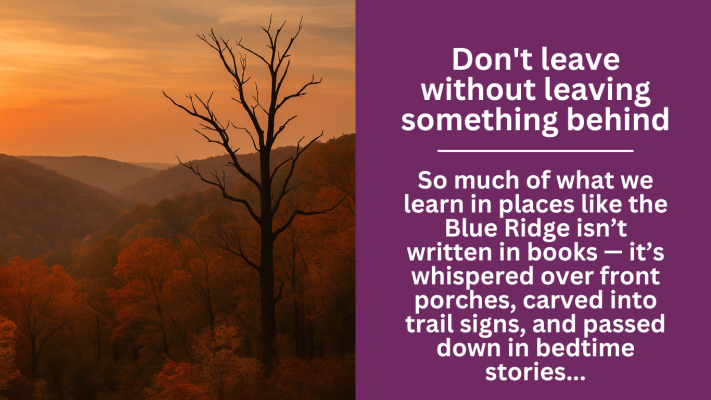
Don’t leave without leaving something behind
So much of what we learn in places like the Blue Ridge isn’t written in books — it’s whispered over front porches, carved into trail signs, and passed down in bedtime stories that blur the line between myth and memory. Whether you believe in spirits or not, there’s power in honoring the unseen, in listening closely to the world around you, and in respecting the lessons that outlived the ones who first spoke them.
If this story stirred something in you — a childhood memory, a hometown legend, or just a deeper appreciation for the wild spaces that shaped you — I’d love to hear it. Drop a comment, share a tale, or pass along a “mountain rule” of your own. These stories aren’t meant to stay buried. They live in us, echoing through the hills and hollow places, waiting to be remembered.


 Gay in the CLE