
Because you deserve to love the man you see staring back.
From the day we are born we are subjected to a barrage of images that define how our bodies should look, what articles of clothing are in fashion, words that will allow us to fit in, and an overall accessible behavior. Add to that the messages our families and friends project towards us and life becomes a toxic swirl of madness that can leave us belittling ourselves over the smallest of things that, in the grand schemes of life, simply do not matter.
And it doesnt stop at our developing stages…
As older gay men, we have seen the brunt of shaming tactics. Body shaming, penis shaming, kink shaming, age shaming, sexual role shaming, and the list becomes longer than our limited lifespans. It is a lot…
Have you ever just wanted to reset that dialogue, to start fresh for your own sanity? Hell, I know I have and I struggle with it on a daily basis. Life can throw a lot at you and if you are prepared, it will take you down the proverbial rabbit hole, just like it did Alice.
- Seeing ourselves through a new lens
- Where the body shame starts
- The mind-body disconnect (and how to reconnect)
- Social media detox (or at least a cleanse)
- Reclaiming desire — on your terms
- The healing is ongoing — and worth it

Seeing ourselves through a new lens
By the time we hit 40, we’ve lived through decades of pressure—pressure to be lean, muscular, youthful, hairless (but not too hairless), smooth-skinned, chiseled-jawed, and effortlessly stylish. For many gay and bi men, the mirror has felt more like a battlefield than a place of self-reflection.
But here’s the truth: we don’t age out of desirability—we just evolve into it. And the work now isn’t about chasing some Instagram-filtered ideal. It’s about healing the internalized shame, comparison, and body dysmorphia that too many of us have carried since our first shirtless locker room encounter or our first glance at a magazine that screamed “Not Enough.”
This is the era of reclaiming your reflection. Of unlearning the nonsense. Of finding peace—not perfection—in the skin you’re in.
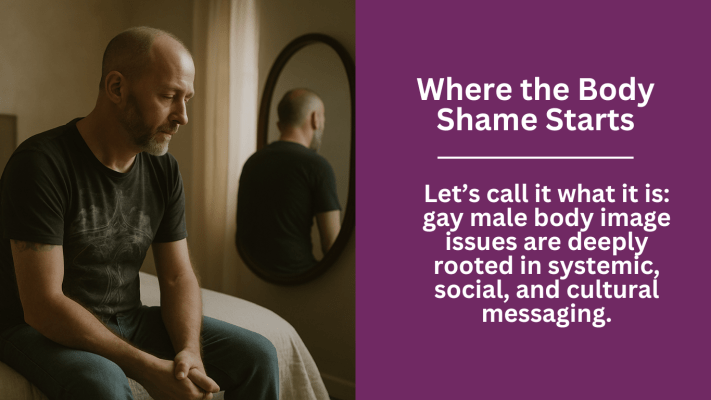
Where the body shame starts
I will admit it… now. I was not the most attractive kid. I was reminded of this, daily, by my classmates and bullies. The truth is that I had not grown into my body. I had a bit of an overbite and two front teeth that stood out a little more than the rest. So yes, Bucky was a constant insult. I was always told my eyes seemed like I was asleep and I was always somewhere on the dreaded “husky” level. My constant anxiety kept me at arm’s length when it came to interactions and I wasnt the best student in school. My social circle were mere dots on the map of my life. I let my peers dictate how I saw myself, and I was in a constant state of depression because of it.
Let’s call it what it is: gay male body image issues are deeply rooted in systemic, social, and cultural messaging. From coded comments in our youth to Grindr filters to that one friend who always jokes about “dad bods”—it adds up.
For many of us, growing up queer meant disconnection from our bodies. We hid them. We feared them. And often, we hated them. Add in the HIV/AIDS crisis and decades of messaging about being “clean,” “healthy,” or “masc,” and suddenly our worth was measured by size, shape, and how desirable others found us.
It’s no surprise that, statistically, gay men are disproportionately impacted by eating disorders, body dysmorphia, and gym-related anxiety. The body became a mask, an armor, a costume we were always adjusting.

The mind-body disconnect (and how to reconnect)
The year is 2025 and I am in a new body, so to speak. If you follow my blog, then you already know that in 2021, I was diagnosed with cirrhosis and high blood pressure These two new health scares set me on a journey to become as healthy as I could possibly be. I started working out five days a week, became a vegetarian, limited my caloric intake to roughly 2200 calories a day, and removed the majority of salt and sugar from my diet and stopped drinking. Needless to say, my body has undergone a radical shift and the results, while having me feeling infinitely better have left the scars of battle on it. Loose skin is the bane of my existence and causes me to retreat into myself and hide from visibility every time I take off an article of clothing, even in front of my boyfriend.
At 40 and beyond, your relationship with your body changes. Metabolism shifts. Joints complain. Skin behaves differently. But so does your perspective—if you let it.
Healing body image isn’t about pretending to love every curve or wrinkle—it’s about building a relationship with your body rooted in respect, not resentment. That starts with self-awareness.
Catch the internal voice that critiques and compares. Ask yourself where it comes from. Is it your voice? Or a ghost from high school, a former partner, or an algorithm?
Learn to check in with your body with compassion, not criticism. Touch your skin like it’s worthy. Move your body like it deserves joy, not punishment. Reconnect with your body as a source of pleasure, power, and intuition—not just presentation.
It has been a journey, and continues to be so, but I try to look at my body with a bit more grace and love. I realize the stretch marks and sagging skin are the badges I have earned for the hard work I continue to put in. My health is better than it has been, minus having cirrhosis, my entire life. I run fifteen miles a week, walk ten miles a week, and do other workouts three times a week. My weight has stayed constant all these four years and while reducing sugar, processed foods, and other harmful things from my diet, I still indulge on a rare occasion. After all, life is about enjoying it, in the body you are in and with those you care about.
Social media detox (or at least a cleanse)
You cannot open a dating app, Facebook/Instagram, porn site, or watch a movie without seeing some chiseled version of what we think everyone is supposed to look like and desire. Those places are unrelenting in their dishing up of items to make us feel less than good about ourselves. The bad thing is that we continue to let them do it to us, we indulge in it, and often seems like we do more to feed the negative feedback loop than we do to elevate ourselves above it.
We can’t talk body image without addressing comparison culture and the curated thirst traps of social media. The algorithms love a sculpted torso and a poreless face—and we’re fed them on loop. But what if you could unfollow the shame?
Take a week and audit your feed:
- Follow men of diverse body types, ages, and expressions
- Seek out affirming, body-neutral LGBTQ+ creators
- Unfollow anyone who makes you feel “less than” instead of inspired
It’s not about silencing the sexy—it’s about redefining what sexy is. And trust me, authenticity, kindness, confidence, and lived experience? Hot as hell.

Reclaiming desire — on your terms
For many gay and bi men over 40, desire becomes more emotional, more spiritual, more… real. We’ve loved. We’ve lost. We’ve survived. And we’re still here—vibrant, evolving, and worthy of being seen and wanted.
You don’t have to shrink to be lovable. You don’t have to punish yourself to be admired. And you don’t have to hide because you no longer look like you did at 28. That’s not the flex it used to be.
Reclaim your body not just as an object of desire but as a source of desire—something that connects, comforts, and expresses who you are in the world.

The healing is ongoing — and worth it
Healing gay male body image after 40 isn’t a one-time journal entry or a single empowering moment in front of the mirror. It’s a process. Some days you’ll feel great. Others, not so much. But every day you choose not to hate yourself is a radical act of queer survival. I struggle with it everyday and the sad part is that one small thing can be the lynchpin that undoes all of my work
Surround yourself with people who uplift, not undercut. Practice body gratitude—even if it’s just thanking your legs for carrying you through the day. And most of all, speak to yourself the way you’d speak to your best friend.
Because the guy in the mirror? He’s been through a lot. And he deserves your love now more than ever.
Remember that setbacks are just that, a setback. You have the amazing ability to be able to reset your thoughts and start to move forward more positively. It is our choice and an easy one to make, the hard part is understanding we are worth every minute of that.


 Gay in the CLE