
Okay, I will admit it, I love Cleveland and my partner shares my sentiment. That does not mean that there isn’t room for our beloved city to improve because there is. With that said, Cleveland, and the surrounding communities, has so much to offer every segment of the population. One of the things that we love best about our city is its entertainment. Just looking at artistic history, Cleveland and Ohio have produced some amazing talent. Actors that have come from here include the likes of Paul Newman, Hal Holbrook, and Halle Berry. Some of the big musicians would be Dean Martin, Dave Grohl, Tracy Chapman, and Maynard J Keenan from Tool. And the list goes on and on.
We both enjoy going to the theater, especially around the holiday. We decided to draw from that love and look of other theater that we could surround ourselves with. That led us to Karamu House and an unexpected delight of a play called “It Happened in Atlanta.” We had met its director when we had gone to a holiday show at Playhouse Square. We instantly fell in love with the venue and that play. We recently got to experience another amazing play at Karamu House called “Choir Boy.” Let’s take a look at it in this article, Choir Boy at Karamu House: A Powerful Intersection of Black Masculinity, Queer Identity, and Cleveland Theater
- Karamu House
- Choir Boy
- Experience is the best teacher
- Race, sexuality, and the power of song
- Life mimics art
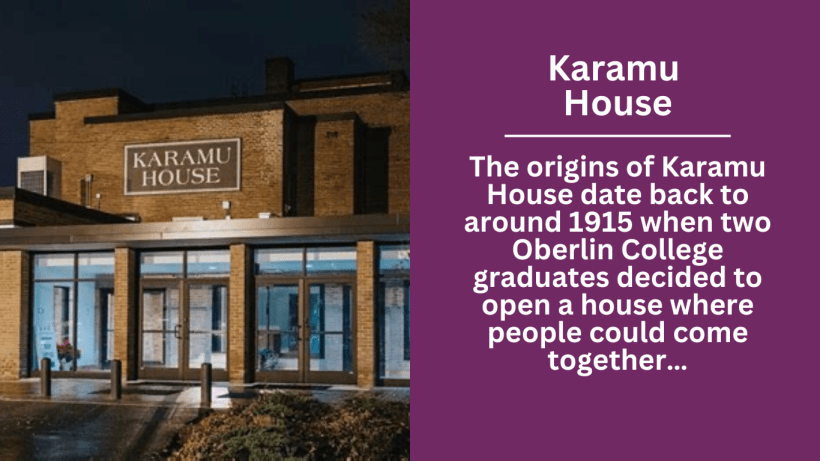
Karamu House
The origins of Karamu House date back to around 1915 when two Oberlin College graduates decided to open a house where people could come together, regardless of race, color, creed, or gender could seek and share common ideas and grow together. Quickly, this became a place for the best African-American artists to come and hone their skills. At the time it was known as the Playhouse Settlement and was a major contributor to the Harlem Renaissance. It would grow from there and with reflecting on the Black influence into its development, it was renamed to the Swahili word Karamy meaning “a place of joyful gathering,” It then became a cornerstone for the community.
Karamu House has a long history of amazing artists taking residence there, most notably being Langston Hughes. However, he would not be the only celebrity to roam the halls of this notable establishment. Some of the rank and file include, Zora Neal Hurston, Ruby Dee, Robert Guillaume (Benso, Soap, and Meteor Man, and Imani Hakim (Everybody Hate Chris and Mythic Quest.)
In a time where we are seeing public schools get rid of music and arts programs, places like Karamu House give youths, who may otherwise have no outlet for their creativity, a place to thrive and grow. It is a place that urges and prioritizes the need for creativity and expression in a world that often wants us to be like everyone else.
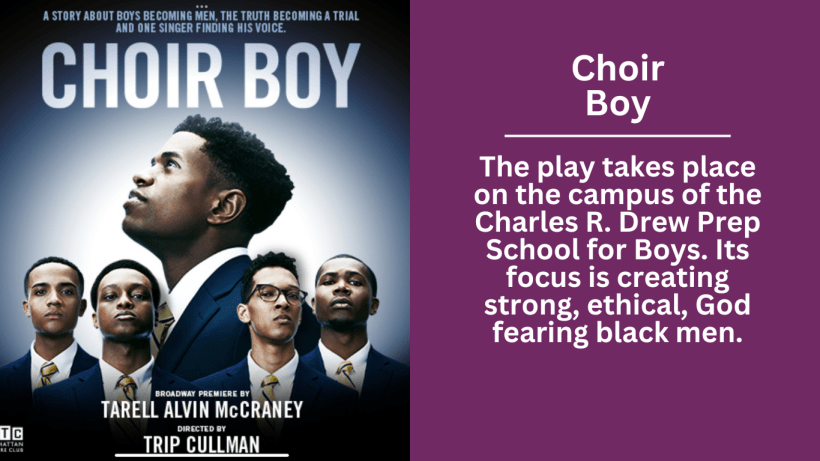
Choir Boy
I will say that as a white gay man of a certain age, I have been at the forefront of the privilege that comes from that station. Due to my height and build, I can often go unnoticed, as a gay man, in crowds. Being white, I dont get a second look very often and as a man, others tend to look at me more differently than they would a woman or a person of color. Choir Boy strips all of that safety and security away. The play takes place on the campus of the Charles R. Drew Prep School for Boys. Its focus is creating strong, ethical, God fearing black men. To grow up with the right morals, convictions, and notions to take on a challenging world and succeed. The play focuses on a group of seven kids who share the common background of being in the school’s choir.
The arching theme of the story is a coming of age drama of a young black man whose main dream is to be the leader of the school’s legendary gospel choir. It is the one thing that alumni come back to see and use as a means of supporting the school and its ethics. Meet PHarus, the young black man who always wanted to be a Drew man and lead the school’s choir in his own “unique” voice.
Choir Boy is a play with music, to be clear this is not a musical. The musical points of the play are used to punctuate the moment, to fill you with a sense of the turmoil that all of the kids are going through, the sense of pride that being a part of this group instills, and to accent the struggles that come from different viewpoints and ways of living. This play allows the viewers to be in an intricate part of the journey of a young boy with a dream that doesn’t quite fit the mold of his peers, a youth that sings to his own chord and the adversity it creates in this tight group of students.

Experience is the best teacher
Choir Boy was written by playwright Tarell Alvin McCraney who is most notably known for his works that explore and challenge and explore the intersectionality of racial and sexual identity. McCraney uses the rich tapestry of his personal experiences to paint vivid pictures that each of us can relate to, in some way. McCraney received his first accolade at the young age of 19. He is most known for his work In the Moonlight Black Boys Look Blue which was later adapted into the acclaimed movie Moonlight.
McCraney is no stranger to a busy life, he devotes his time to pursuing his own work as well as giving back to underserved communities. He hold a position of Chair and Professor in the Practice of Playwright at Yale Repertory Theater and is a member of Teo Castellanos/D-Projects Theater Company in Miami, to name a couple.
McCraney felt the need to share his observations and reflections on the intersection of masculinity, sexuality, and race, especially within the African-American community, Choir Boy perfectly blend the complex nature of the pressures young men face in trying to be themselves while fitting into societal norms, something that is still relevant and important in today’s world.

Race, sexuality, and the power of song
The background for Choir Boy takes place in an all Black preparatory school for young men. Each of these schools were charged with giving young black men the skills and belief systems needed to face a world where they would have to work hard to achieve their dreams in a world that was built against them. It fostered community and brotherhood as well as gave them a place to be themselves without fear of hatred from other classmates. Choir Boy showcases a perfect blend of what its like to attend one of these schools especially if you are slightly “different” than the rest of your classmates.
Being gay isn’t easy for anyone but coming from communities where masculinity is central to how you present yourself, it can be extremely difficult. The particular school was based on the principles of education, church membership, civic knowledge, competency, responsibility, and independence. The main theme of this play is self discovery and developing an identity that feels genuine to yourself. There is no better time in a person’s life to showcase these ideals than a coming of age story, that liminal time between youth and adulthood where the lessons we learn are supposed to be the foundations for our lives to come. This discovery is set to the tone of homosexuality and Black masculinity. This play dives deep into showing how the prejudices of homosexuality are the same ignorance, political, and misguided religions beliefs that have often been used to segregate against the African-American community for decades.
The play shows the boys coming into who they want to be, defining their beliefs, as well as struggling with the values they are being taught and how they interact with life, at large. Choir Boy shows how internalized hatred of homophobia affects the person battling with who they really are in relation to what they think the should be, while also showing how that hatred affects us from those around us. In a world that prized individuality, it is only acceptable when that individuality is based on a predetermined idea of who you are supposed to be and how you should act.
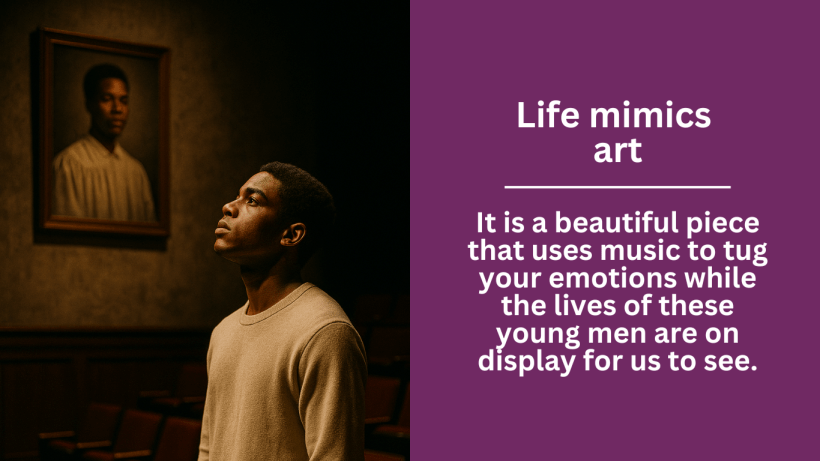
Life mimics art
Alvin McCraney has created a beautiful play that, while set in the distant past, is still relevant today. It forces us to see and understand the limited ideals we may often be strapped down with from our upbringing. Whether that be the ideals taught to us by our parents or institutions of higher learning. It is a beautiful piece that uses music to tug your emotions while the lives of these young men are on display for us to see. Whether you are Black or White, Queer or Straight, there are lessons to be learned, for each of us, in this powerhouse of a play.
Just remember that, we as Clevelandars, have a wealth of arts, culture, music, and more at our very fingertips. At any given moment, there are so many things to experience and be a part of that there is never a time to sit back and say “I’m bored.” The talent this city has given the world is amazing and what it may still give up to the world cannot simply be understood, yet. From local theater, small venues for live music, incredible foodie options, to break taking vistas, this area has so much to give. You only have to get out there and pick one to try.
What about you, what things do you love about Cleveland or what small gems would you share with others to show how amazing this area can be? Let me know in the comments below. Once again, thank you for being a part of GayintheCLE.


 Gay in the CLE