
Winter weather doesn’t have to freeze your running progress—but how does swapping snowy trails for the treadmill training affect your spring performance? The one thing I have hated, since I started running, is lowering my training throughout the winter. When I lost all of my weight, the first big noticeable change was maintaining body heat – I feel cold almost all the time. If my hands and feet get cold, it is next to impossible for me to warm up, even when I am running. Also, having asthma makes it harder to run in the cold. As a result, I typically don’t run in weather under about 35’ F.
So, what does a runner do if the weather doesn’t cooperate? They move inside or use a treadmill. I opted for the latter, as it was easier than paying for a gym membership just for a track to run. But I noticed some disconnect when it came to picking my regular routine back up when the temperatures slowly became warmer. Many runners use treadmills as part of their training, especially during the winter months. However, transitioning back to terrain running can give us some benefits and, especially, challenges. Let’s explore how treadmill training can impact your terrain running and maybe offer some tips that may help your transition. Let’s dive into How Winter Treadmill Training Effects Running in Spring.
- Treadmill training during winter
- Challenges of transitioning back to terrain running
- How to optimize treadmill training
- Tips for transitioning back to terrain running in spring
- Crossing the finish line

Treadmill training during winter
As winter approaches, I start formulating a winter training plan to keep me active and not lose any ground over winter. Last year I focused on running slow to build up endurance. This year, I added more incline to my running and decided to work on my SPM. My thought was that this would leave me in a good place to start running in warmer weather. Boy, was I mistaken.
Each year, as the temperatures start to rise and the days get just a tad longer, I yearn to be outside running. That is a weird statement for me to say, period, but as a runner, it makes complete sense. I dont know many runners who actually enjoy running on a treadmill indoors. It is the same scene every time, sure you can mix it up by watching virtual running videos and adding your own playlists. Or, maybe you are one of the runners who will binge their favorite series, movies, or documentaries while running, but it still doesnt change that a treadmill is more repetitive than terrain running.
What is good about using a treadmill in winter is that it will allow us to continue our training to keep up our cardiovascular fitness. If we stopped running for the entirety of winter, getting back out in spring would be like a huge reset. Then there is the fact that you dont have to deal with snowy/icy pathways to impede your training. Even better, your temperature is consistent, so you dont have to worry about any weather issues and running.
Treadmills also give us the ability to focus on important things like form and technique. Sure, if you only want to get out there and just run, then focusing on form and technique dont offer a lot of incentive for you. But, if you want to improve, run longer, or simply get the most benefit out of it, then training for breath, speed, and SPM will be vastly beneficial. A treadmill will allow you to focus on foot srike positioning so you are overly striking. You get to ensure that you are maintaining a full upright runner’s stance, and pick up your cadence. The easy repetition that a treadmill gives allows you to focus on those metrics much easier and see improvement. Heck, it is even a good way to start working back from an injury as it tends to be easier on the body and the affected areas.
All seem like a win to me, right? But is it a win? Does treadmill running prepare you for real terrain running? Let’s look further.
Challenges of transitioning back to terrain running
”Q: Does treadmill running prepare you for outdoor terrain?
A: Treadmill running helps maintain cardio fitness but lacks the terrain variability of outdoor running. Adjusting to natural surfaces require additional training.”
Winter treadmill training keeps you active and fit, but when spring arrives and it’s time to hit the trails again, many runners experience unexpected challenges. While your cardiovascular endurance may still be strong, other factors—like terrain variation, mental stamina, and muscle adaptation—can make the transition tougher than expected. Here’s what to watch out for when making the switch from treadmill to outdoor running.
1. Lack of Terrain Variability
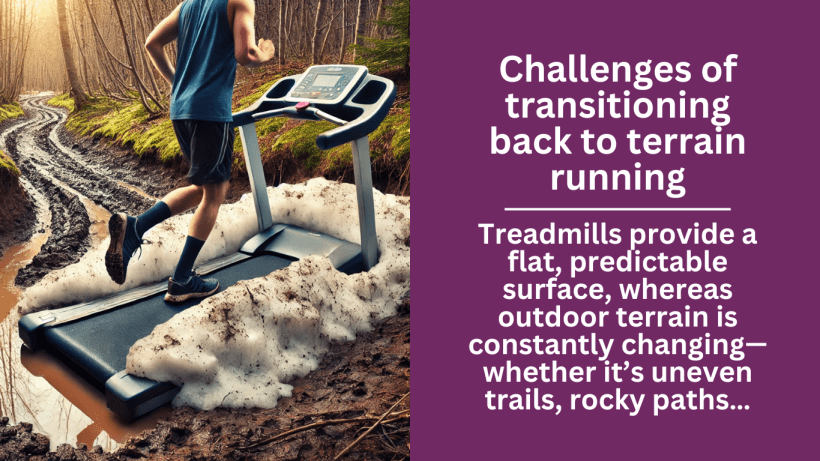
One of the biggest differences between treadmill and outdoor running is terrain variability. Treadmills provide a flat, predictable surface, whereas outdoor terrain is constantly changing—whether it’s uneven trails, rocky paths, hills, or unpredictable ground conditions like mud or gravel.
Since treadmills don’t replicate the natural foot stabilization required on outdoor surfaces, runners often find that their ankles, calves, and core muscles aren’t as prepared for trail running or even hilly roads. This can lead to increased fatigue, soreness, or even a higher risk of minor injuries like ankle sprains if the transition is too abrupt.
Solution: To counteract this, gradually introduce outdoor terrain runs into your routine, starting with flat, paved routes before progressing to trails or hills. Strength training that targets stabilizer muscles (like single-leg exercises and balance drills) can also help ease the transition.
2. Mental Adjustment to Outdoor Conditions
Running on a treadmill eliminates environmental distractions—no wind, uneven pavement, or changing temperatures—allowing you to focus solely on pace and endurance. But once you step outside, factors like wind resistance, temperature fluctuations, and shifting elevations add new layers of challenge.
Additionally, treadmill running often includes built-in pacing tools, making it easier to maintain speed. When running outdoors, self-regulating your pace without the guidance of a digital display can feel more mentally demanding—especially if you’re used to treadmill feedback.
Solution: Ease into outdoor running by starting with shorter distances at a moderate pace before attempting intense workouts. If pacing is a challenge, consider using a GPS running watch to track your speed, or run based on effort level rather than specific mile splits.
3. Over-Reliance on Treadmill Comfort Features
Treadmills provide a smooth, cushioned surface, making runs feel easier on the joints compared to harder outdoor surfaces like concrete or asphalt. Additionally, adjustable inclines allow runners to mimic hills without the real-world strain of gravity and ground impact.
Because of this, transitioning back to outdoor running can sometimes lead to unexpected soreness or fatigue, especially in the feet, calves, and lower back, as your body adjusts to natural impact forces again.
Solution: Incorporate progressive outdoor runs to allow your muscles and joints to recondition gradually. Pay attention to how your body feels and increase mileage slowly to avoid overuse injuries. If you primarily trained on a treadmill with incline settings, start with moderate hills outdoors before jumping into steep inclines.
How to optimize treadmill training
How to optimize treadmill training
”Q: How do I transition from treadmill running to outdoor running in spring?
A: Gradually reintroduce outdoor runs, focus on stabilizing exercises and use treadmill incline settings to simulate natural terrain.”
While treadmill training is a great tool for maintaining fitness in the winter, it’s important to recognize the unique challenges that come with transitioning back to outdoor terrain running. By gradually reintroducing outdoor runs, strengthening stabilizer muscles, and preparing mentally for environmental changes, you can ensure a smooth and injury-free return to the trails this spring.
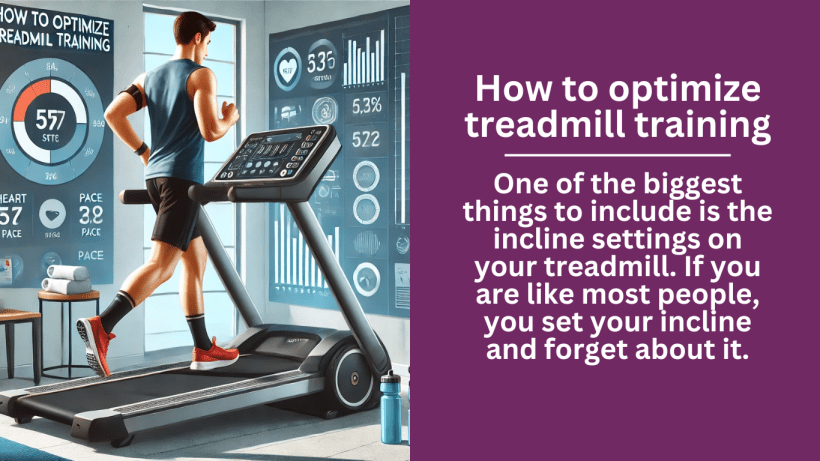
So how can we optimize our treadmill training during winter months to leave us in a better position when its time to start hitting outside again? One of the biggest things to include is the incline settings on your treadmill. If you are like most people, you set your incline and forget about it. Then, every run is exactly the same and you end up using a very specific set of muscles to power through it. Terrain forces us to use a multitude of muscles, constantly. Our feet and legs are making micros adjustments for the varying terrain, our muscle groups will push out more energy when they think we need more speed or power and will dial back if we are straining. On your treadmill, you can change the incline up and down to help simulate the varying terrains you encounter outside. Incline to simulate hills and decline to simulate going down hill.
You can also, easily, incorperate speed and interval training to your treadmill. It is no secret that it requres much less, overall, effort to run on a treadmill than on terrain. The treadmill is constantly moving at the speed you set it at and you simply need to be going fast enough to maintain movement. But, adding and reducing speed can add new dimensions to training. You can even do interval running on a treadmill to help keep your cardio training where it needs to be.
Let’s not forget that training isnt just about the treadmill. Like terrain running, you need to add other components to your workout, to give a full body training experience. Add strength training exercises like lunges, squats, leg balances, and more to keep those muscles engages during winter when you dont have access to the terrain you normally use. Maybe throw in a fan to simulate wind resistance and change out the temperature in the room you are training in. All of these can help simulate an outdoor environment in a controlled situation.

Tips for transitioning back to terrain running in spring
Every year, it is the same, for me. I do my winter training on a treadmill in anticipation of the day that I can get back out to running in nature. I add things to my routine in the hopes that I wont lose any ground over winter, only to find out that my first few outside runs hit me like a ton of bricks. Then I am left wondering what the hell I did wrong. Each first couple of runs engage the muscles I had forgotten about and thought were getting work, I hit the terrain at a faster speed than I should and usually hit a wall about halfway through my run. It is frustrating and often leads me to think I don’t know what I am doing or doing it all wrong. I was shocked when I found out that this is normal, based on what I am doing for training.
What are some of the best ways to transition from treadmill to outdoor running?
- Start slow and gradual – This almost seems like a no brainer, but from experience, when you hit your terrain, that first run, your body remembers how easy the treadmill runs were and says “We got this!!!” Plain and simple, start slower than you think you need to be. Make it a shorter run than you had been doing and gradually increase as you get accustomed to it. (Dont do like I do and go all out on your first run.)
- Focuson terrain specific training – You just spent the last few months running on a surface that doesnt change. You need to find areas a where you can start working on the muscles you forgot to train. Look for terrain with varying details, steep, flat, rocky, paved, and etc. Alternate between a road run and a trail run. These will go a long way in a short amount of time to get you back into proper conditioning.
- Rebuild mental stamina – Whether you realize it or not, running outside requires a lot of mental endurance, as well as muscular endurance. Varying terrain, wind resistance, natural obstacles like other runners, walkers, animals, and conditions are all a part of that challenge. Try running without music to help you focus on your surroundings and your footing more.
Crossing the finish line
While treadmill training is a great tool to stay fit during the winter, it’s important to recognize the adjustments needed when transitioning back to outdoor terrain. By combining smart treadmill strategies with gradual outdoor reintroduction, you can hit the trails stronger than ever this spring. It can be really helpful to try to work in one outside day a week, in your winter training, to help keep that conditioning going. When you are ready to run outside again, remember start slow and gradually increase as you improve. During winter you can focus on adding more strength training and varying types of running to your regular routine to get your body back into running form. These simple tips have done wonders for me and hopefully will help you also.
What’s your favorite way to transition back to outdoor running after winter? Were there tips I shared that you had not thought about before? Maybe you have some that I didn’t mention that have helped you transition back to running outside after winter. Share your tips in the comments below! Thank you for being a part of GayintheCLE. Without each of you, I could not continue to do this. Thank you, all!


 Gay in the CLE