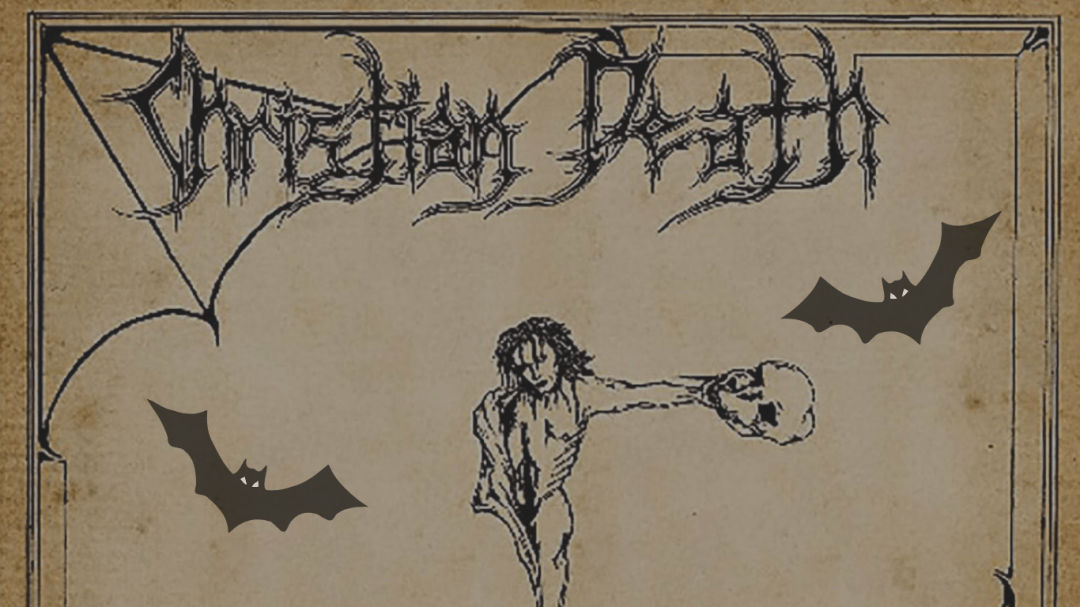
There are things, in life, that have an amazing ability to transport us back in time. Smells are one of the biggest things that can achieve this. A hint of almond or vanilla and suddenly you may find yourself in the kitchen of your mother or grandmother. The smell of a new book may remind you of the first time you fell in love with books as a child. But there is another, equally as strong sense that has this ability… sound. There is not a time that goes by that when Creedence Clearwater Revival’s Bad Moon Rising comes on that I am not instantly transported back to my early childhood. My family having a cookout in my childhood home, my father wearing a Budweiser baseball cap, and a record player pulled outside to listen to vinyl as they drank. Ahh memories… So, it is not surprising that a voice that was a mix of somewhere between Alice Cooper and Donovan Leitch could transport me back to my younger self as well. That voice is none other than the sex dripping tones of Rozz Williams of the goth group Christian Death.
In the early 1980s, a dark and theatrical new sound emerged from the underground punk scene, giving birth to what would later be known as deathrock. At the forefront of this movement was Christian Death, a band that not only defined the genre but also reshaped the trajectory of goth and alternative music. With their haunting melodies, macabre aesthetics, and deeply provocative lyrics, Christian Death, led by Rozz Williams, fused elements of punk, post-punk, and gothic atmospheres to create a sound unlike anything before it. Their 1982 debut album, Only Theatre of Pain, set the foundation for deathrock, blending existential despair with religious and political critique. The band’s ever-evolving lineup, later led by Valor Kand, carried the legacy forward, stirring controversy while expanding their sonic reach. This essay explores Christian Death’s origins, their influence on the deathrock movement, and their lasting impact on goth and alternative music.

Early days of darkness
The world becomes a swirl of blacks and greys, time slipping into eternity – reaching forward and behind in a line that never ends. In a blink, the year is 2001 and I am standing behind the sales counter of the once goth super haunt of Hot Topic. I was one of two co-assistant managers, the other a very North Carolina punk chick named April looking at me excitedly waving a CD trying to get my attention, “Do you love Christian Death?” At first, I was somewhat confused and replied, “While I think Christians are the root of a lot of problems in our world, I;m not sure I love their deaths.” She laughed at me, made some remark about me being funny and then dropped a cd into the disc changer every Hot Topic had and pressed the corresponding button. The opening of the first song intoned over the speakers “I wish you were dead…”, loudly, before we opened for the day. Soon after, the melodic sorcery that is Rozz WIlliams oozed from the speakers like warm honey pouring out of a jar, sticky and sweet. Instantly I was in love and that album was only a remix album titled Death Mix, released in 1996. Immediately I was hooked.
Christian Death was raised from the darkness in October of 1979 in Los Angeles County, California. This version of Christian Death leaned heavily on the punk aesthetic of the time and was the results of guitarist Jay Albert, bassist James McGearty, drummer George Belanger, and, of course, vocalist Rozz Williams. According to the band, its earliest inspiration was from the iconic, but short lived, Germs. Over time, the band started to evolve their sound. Their music slowed and they switched to singing about more religious themes. The new version of Christian Death took the stage for their first performance in the historic Hong Kong Cafe in Los Angeles. This would be a memorable night. Prior to this performance George Belanger had been involved in a fight and suffered injuries that would prevent him from drumming that night. Rozz reached out to friend, Steve Darrow, to cover the spot. Belanger decided that he wanted to try it anyway and made it halfway through their set before he had to step down for Darrow to finish. Bandmate Jay Albert was completely angered by this and decided to leave the band after that night. The first in many changes to come for this iconic band.
The band decided to put the project on hold. Albert and Rozz decided to create a side project called Daucus Karota. A few short months later the band would reform with new guitarist RIkki Agnew. This would be the mix that landed them their first song to ever grace vinyl. In 1981, “Dogs” was included on a compilation album that showcased southern California deathrock and punk bands, called “Hell Comes to Your House.” Just one year later Christian Death would be signed to Frontier Records and their debut studio album Only Theater of Pain would be released on March 24, 1982.
One year later, Belanger would leave the band due to becoming disheartened with where things were heading and the increased drug use by other band members. China Figueroa would take his place as drummer. Just before their very first tour, Rikki Agnew’s drug use would become an issue. Many nights, Agnew would become panicked that Rozz, Ron Athey, Agnew’s boyfriend, and he would be subjected to homophobic attacks in the southern parts of their United States tour or arrested for their drug usage. This panicked him to the extent that he would leave the band before going onstage on their first tour stop. To get through this tour, the band hired Mikaleno Amundson to play guitar. A dispute among the band’s girlfriend ended Amundson’s time with the band just a few short stops later. Before the year was up, the band would cycle through three more guitarists before McGearty left the band. The band would make it to 1983 before Rozz was the only founding member left. With that they disbanded.
Rising from the Ashes
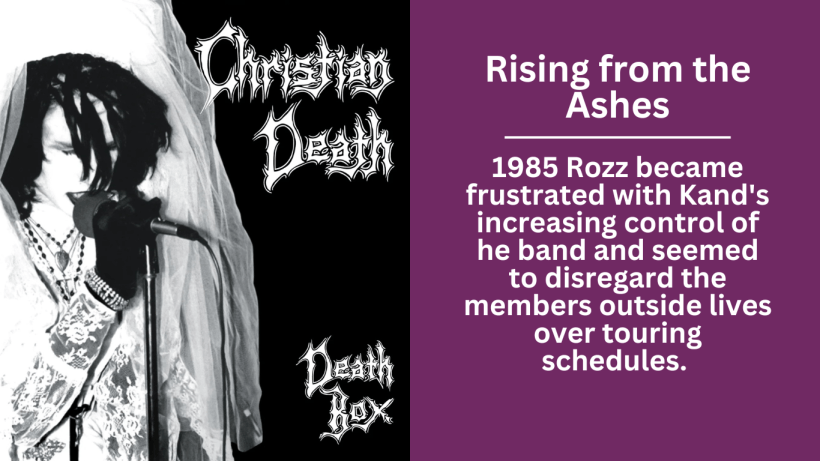
While Christian Death saw its first setback in 1983, Rozz was unswayed in his vision. He joined the group Pompeii 99 with its members; guitarist/vocalist Valor Kand and drummer Glass Prkinson. Rozz urged the band to bring inKand’s partner, Gitane Demone, as their keyboardist. This would be the first change that Rozz brought to this band. Shorty after the addition of Demone, French record label L’Invitation au Suicide approached Rozz to record another album and do a European tour. The band reached out to Constance Regrave to join them as bassist and the band became the resurrected Christian Death. This lineup would create their next album, Catastrophe Ballet in 1984. This album was the critical move away from their punk roots to their sound that would go on to be the influence for the deathrock scene. Shortly after its release, the band lost another member, bassist Cinstance Smith. This led for Dave Roberts, Sex Gang Children, taking up bass. The band returned to America in 1984 and recorded Ashes in 1985. Roughly, halfway through 1985 Rozz became frustrated with Kand’s increasing control of he band and seemed to disregard the members outside lives over touring schedules. He had tried to talk Gitane Demone into leaving as well, however Kand and Demone had a child together which prompted her to stay.
In reverence to Rozz’s departure, the band made various attempts at changing the name from Christian Death to Sin and Sacrafice, however, due to a booking agent error, the band went on tour as Christian Death. From here, there were offered a new record deal from the label Supporti Fonografici but only if they accepted as Christian Death and included bassist Johan Schumann and guitarist/keyboardist Barry Gavin. Their recorded an EP for the label that was titled The Wind Kissed Pictures and was created to “For Sin and Sacrifice Must We Must a Christian Death.” But this would not be an easy death.
In the 1980s, Rozz created a side project called Shadow Project, which would prove to be the resurrection of Rozz’s version of Christian Death. This resurrection would combine Rozz’s wife, Eva O on guitar and vocals and the return of Agnew to guitars, as well. Cleopatra Records could sign them under Christian Death for their return album The Iron Mask and an EP Skeleton Kiss in 1992. Rozz reclaiming the original band’s name incited Kand to lash out and started a fight about rights of the name. Unfortunately, it was a battle that Kand would ultimately win, as he held rights to the name due to Rozz leaving previously. In spite, Rozz retooled the name to be Christian Death featuring Rozz Williams. Rozz would release two more albums and tour with the original members of the Only Theater of Pain members where they recorded a live album at Los Angeles’ Patriot Hall, that would later be released in 2001. Williams would go on to pursue other side projects before ultimately committing suicide on April 1, 1998.
Christian Death without Rozz
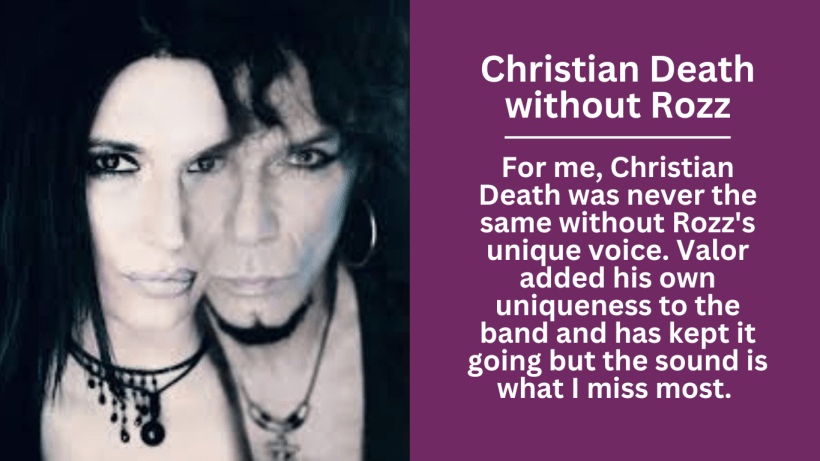
For me, Christian Death was never the same without Rozz’s unique voice. Valor added his own uniqueness to the band and has kept it going but the sound is what I miss most. Though Valor has continued putting out music and staying true, as possible, to the band’s original concepts. They created the genre of American goth rock, was the influencer to Death Rock and born of the protesting roots of the punk scene, Christian Death has stood against organized religions and conventional morality since its inception. Their shows were dripping with theatrics that took their cues from the likes of David Bowie and pioneer industrial artist Throbbing Gristle. Their music fit the early 80s goth culture perfectly, with their slow, doom laden, guitars and a heaving leaning into macabre soundscapes.It became the avenue for American goth and punk kids to express their rebellion and feel seen.
Today the band still consists of Valor Kand and Maitri,they try to maintain the eerie quality that Christian Death has been known for. Their stage shows often take on an air of medieval goth with Valor wearing scale mail shirts and headpieces and videos that are still reminiscent of Bauhaus and Type O Negative. It is nice to see that a goth band from the 70s and early 80s still has the staying power to entrance future goth kids. For me, the essence may be the same but the fire that was Rozz has changed. The haunting quality of his voice that seemed to slice you to your very soul is missing from where they are now. Maybe it is just me, but sometimes classics are still the best.
What about you, faithful readers, did you listen to Christian Death, at some point, in your past? If so, what are your thoughts on their musical styling now versus then? Maybe you just heard of them in this article, what do you think of them? Are they to your liking or is it too over the top? Let me know in the comments below. Remember to keep it spooky and thank you for being a part of GayintheCLE. Without you, this site would not exist.


 Gay in the CLE