
I sit here, in my study, this morning reflecting on Joe Biden stepping out of the Presidential race for 2024 and Kamala Harris. I am filled with a myriad of emotions, fear and worry for myself and my boyfriend loom in the darkest recesses of my mind. What will life be like if Trump is re-elected? Will a new candidate be found that can actually run against him and win? Will their views be any better? It’s a lot to take in and consider and I mostly dont want to think about it.
What these thoughts sparked was memories from early middle school and reading Shirley Jackson’s short story The Lottery. It somehow seems appropo, this morning. Join me as I share memories and thoughts about this classic, today, in a article called, Lottery Day Came Early: A Look at Shirley Jackson’s “The Lottery” Through a Modern Lens.
- The Unconventional Mentor
- A chilly and chilling classroom tale
- The Lottery: A Chilling Reminder of Tradition’s Dark Side
- The Lottery’s enduring message

The Unconventional Mentor
I had a few teachers in my school life that left indelible marks on me, usually because they challenged and altered the way I thought and saw the world. There was one who saw my thirst for reading and taught me to question everything. This teacher used English and Literature class as a means to try to teach her students to see the world through questioning eyes, to not simply accept what was given to us, and think beyond the rhetoric of the masses. That teacher was Mrs. Sword
Mrs. Sword was a small woman of a stout nature with long straight hair and a sort of hillbilly, punk rock vibe to her. she collected the kids who were on the fringes of school. Writers, actors, and free thinker flocked to her because she allowed the the space to think and create without judgement or limitations This did make her the most popular teacher. She showed us how companies and marketing would use words, images, and subliminal persuasion to get their points across, while teaching us about authors who spoke out against the status quo. Authors like Kurt Vonnegut, J.D. Salinger, and, yes, Shirley Jackson.
Mrs. Sword’s class was where I first read and watches 1984 and Fahrenheit 451. She was the first teacher that taught that just because somoene is in the government doesnt mean they have the best interests of the people in mind. As the drama teacher, she picked plays that made kids think about values they were being taught and hoe limited viewpoints could lead to disastrous outcome.In short, she taught us to use our mind and values to measure everything we heard for its validity and viewpoints.

A chilly and chilling classroom tale
Many specifics about this particular day escape me, but here is what I remember.
It was a cold day and we, sixth graders, marched our way out of the main building of Auburn High School and made our way to the log cabin that sat, somewhat lost in time, in the back corner of the school grounds. It was nearest the practice baseball field and was connected to the old community canning building. Many of our parents had told us memories of their childhood where they would bring their harvest produce to the cannery to be canned for their usage. The cabin was a relic of this bygone era and had not been updated much since its beginning.
The cabin was divided into two separate classrooms. In our classroom, there was an ancient fireplace that had been blocked off and two sets of windows that still had the original panes of glass in them. They were thin glass and the window sills had cracks all around that woudl let in the winter chill or cool spring breeze – depending on the year. In the corner sat the desk Mrs Sword used and it sat at an angle to survey the whole class.
On this particular day, each desk already had a staples packet of papers with a large line of texts that read The Lottery by Shirley Jackson. Some of us tried to guess what the story was about, but were quickly told to sit down. As class came to session, Mrs Sword gave a brief introduction about Shirley Jackson and the story. Then, as was our normal routine, we took turns reading paragraphs of the story.
If you have never read The Lottery, then let me share a little about it. It is a dark tale set in a small New England village. It is a town full of people who have lived in their for generations. Customs have been around, for the village, as long as it has been. People blindly followed old customs without a thought for the reason or if they were still viable. One such custom was the lottery. No one in the village remembers why it was started, just that they have always done it. The story shows that even the custom of the lottery has changed over time but the tradition still happens each year in June. No question, just blindly following custom.
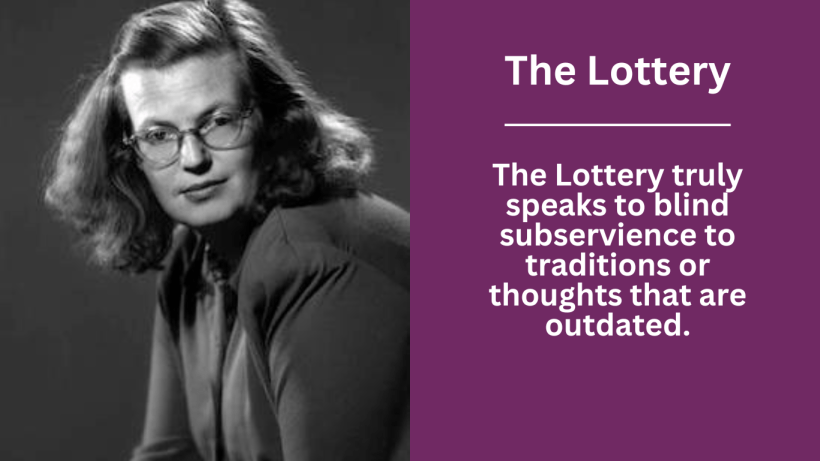
The Lottery: A Chilling Reminder of Tradition’s Dark Side
The Lottery truly speaks to blind subservience to traditions or thoughts that are outdated. It shows a town so caught up in believing that things shouldn’t change that they dont see what may be in front of them. We, the readers, are never made privy as to when or why the lottery started, only that it continues to this day. We even see that the tradition has been changed, but the residents simply continue doing what they always have done.
Apprehension fills each resident as the lottery ensues and wait on bated breath until the results are announced. Once they are, the apprehension abates and the need to fulfill the duty of the lottery sweeps over them. Once the results are handed down, the residents return to their normal lives, as if nothing out of the ordinary has happened. The brutality of the vein it lost to history and tradition.
We see kids laughing and joking as they collect and stack rocks, adults talking about their neighboring towns and how some have changed to two lotteries on their given days or how some have ruled them out, completely. The lottery is carried out by the men of each household and when there is no man, they simply shift it to the wife or a stand in for the family. What the story speaks loudly to is the blind following of rehetoric or people without thinking for ourselves. It cautions us against the darkness of conformity and following traditions without questioning them.
These are thoughts that are just as relevant as when Shirtly Jackson wrote this cautionary tale. Many still debate over what Jackson was trying to say. Some saw it as direct opposition to the draft services, some have made comparison to the death penalty, but what is clear is there connection to many events in history and the possibly futures they provoke. One big connection to this story and history is the case of Anne Hutchison, the protagonist of the story is called Tessie Hutchison. Anne Hutchison was banished from Massachusetts in 1638 for her beliefs against Puritanical rulings of the time. Anne was cast out from her village based on an unfair and heavily male dominated trial. Whereas,Tessie was questioning the validity and correctness of the continuance of the lottery. She sees how men are the ones who are made to make the choices for women and children, unless there is no other viable option. It really drives home the second class feel of women at that time.
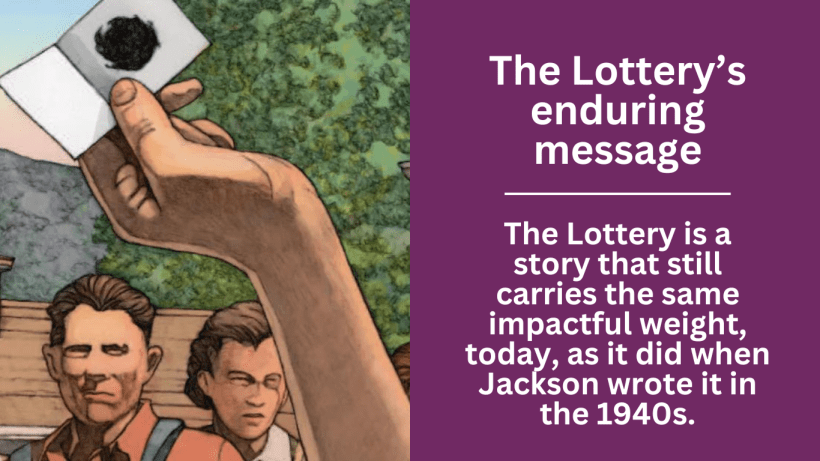
The Lottery’s enduring message
The Lottery is a story that still carries the same impactful weight, today, as it did when Jackson wrote it in the 1940s. It should be seen as a wake up tale for every minority status out there. It is a teaching that drives home the need for each of us to take control in our lives to make the best decisions for us and not leave them to others to make by our non-action. In this time in our great republic of the United States, this cannot be more important. Our lives are being decided upon by people who give no thought to us or our freedoms, only their wallets. We need to be the ones to question the very things that have come before us and demand reform on the things that no longer serve the best interest of the people. Otherwise, we are all left waiting to be stoned out of existence by someone else.
What about you? Did you read this story in school? What were your thoughts on it then versus now? Do you feel that it still carries weight or is it just some flight of fancy that someone made up purely for enjoyment and consumption? Let me know in the comments below. And remember, no one will speak fo you any louder than you can, make your voice heard to the masses. Educate yourself on history, politics, and what platforms our candidates run on or the lottery may be coming fro you next.


 Gay in the CLE