
Humans have been granted an amazing gift when it comes to words. Words express ideals, create works that can inspire or challenge us, create worlds beyond our imagination, and open viewpoints in ways we may not have known. There is no greater expression of words than literature, whether it be poetry, short stories, or epic novels. The are the fertile grounds to grow civilizations or destroy outdated belief systems. Words are power, if you use them and learn from them.
Imagine a world that is devoid of color, emotion, and free thought. A world that is shades of grey, white, and black. Where you are told what you will do each day, what you will learn, what you will become, and what you can think. Any deviation from that track will end in punishment. Leaders make speeches on television telling you how the world is and what you should think about it. They tell you what job you will have, where you live, how many children you can have and who is suitable for you to be with. If you think this sounds a lot like the book 1984 or Fahrenheit 451, you aren’t too far off, as this is the very type of thing they spoke of and what comes from banning books.
Today, let’s dive into Is Book Burning a Threat to a Free Society? What It Means for Our Future. and see how book banning can cause issues.
- Lessons from Literature
- Books: The windows of the mind
- Book Banning in America: From Puritans to Public Libraries
- Growing at the speed of the internet
- Live, Learn, Grow

Lessons from Literature
I sat in my study this morning, watching the sun slowly rise above the horizon. As the world slowly awoke from its slumber and the first birds started their morning singing I was treated to an article about the increasing numbers of book bans across our country. Suddenly, the warm, loving light of the sun seemed somewhat diminished and a tinge of sadness entered my heart.
At that moment, I was taken out of the present and transported back to my childhood. My senses were filled the the intoxicating scent of the pages of the book I was holding in my hand. As my reality slipped to this memory the words on the page started to fill my memory. The story of Br’er Rabbit and the Tar Baby fills my mind.
The story is about how Br’er Fox decides to play a trick on Br’er Rabbit, to finally get rid of him. Br’er Fox crafts an badly out of tar and turpentine and props it up on the path that Br’er Rabbit takes each morning. Br’er Rabbit comes along and greets the tar baby but gets no response. Br’er Rabbit continues his talking and starts to get upset at the lack of response. In a fit of anger, Br’er Rabbit punches the tar baby in the face and gets his hand stuck. Br’er Fox pops out the bush knowing that he now has Rabbit in his grasp. Br’er Rabbit sees his predicament and tries to escape. Seeing that he cant, he tells Br’er Fox to do anything with him that he wants as long as he doesnt throw him in that briar patch, over there. Thinking this would cause Rabbit more pain and harm, he tosses Rabbit into the briar patch. Rabbit starts screaming and quickly turns to laughter as he is now safe from Br’er Fox and his trap.
This story taught me not to take things at face value and that anger is not always the answer to our problems. Br’er Rabbit acted irrationally when he thought he was being ignored and fell into a trap laid by his enemy. When confronted with the fate of his actions, Br’er Rabbit changed his course of action to benefit him. These are great lessons for a child to learn and to think that a banning of a book could prevent those lessons from being taught should cause the kind of anger that Br’er Rabbit felt at being ignored and cause us to asses our situation and find ways to escape the systems that are put in place on us.
The land of the free and home of the brave, unless your thoughts conflict with the majority.
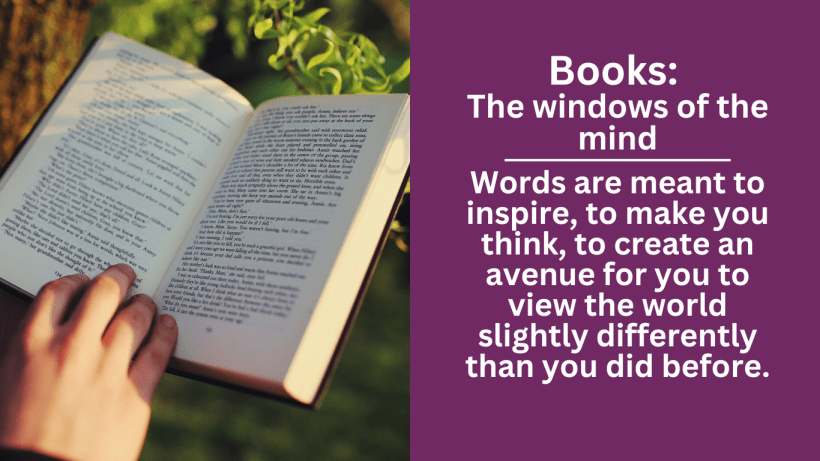
Books: The windows of the mind
“A house without books is like a room without windows.” — Heinrich Mann
The very word of this quote strikes such a blow to me that it is almost tangible. What does it mean? Or better yet, what does it mean to you? Words are meant to inspire, to make you think, to create an avenue for you to view the world slightly differently than you did before.
My sister and I were fortunate enough to grow up in a household where we had a parent who was an avid reader. I cannot remember a time where I ever saw my mother that she did not have a book on her. She urged us to read, anything and everything, all the time. In school, we had family members who were librarians who made it a point to show us the wonders and joys that could be found on each page that lay between the covers of worlds that we could never visit, physically.
Reading opens up your mind to new experiences that may not be easily had, otherwise. You are allowed to become a knight fighting dragons to win the love of a fair maiden, or travel to worlds that no person has stepped a single toe on. Each page changes our perception of knowledge and viewpoints. The words are meant to inspire, to challenge, to cause a reaction, and to entertain. Each book is a window unto a new world, no, each book has the capacity to shape your mind and challenge how you see it. It is meant to question old thoughts and inspire us to be greater than we were before. Books allow us the freedom to create our own narrative, out own thoughts, and our own viewpoints. They remove the shackles of tyranny and control, books, like music, are the language of the soul and mind.
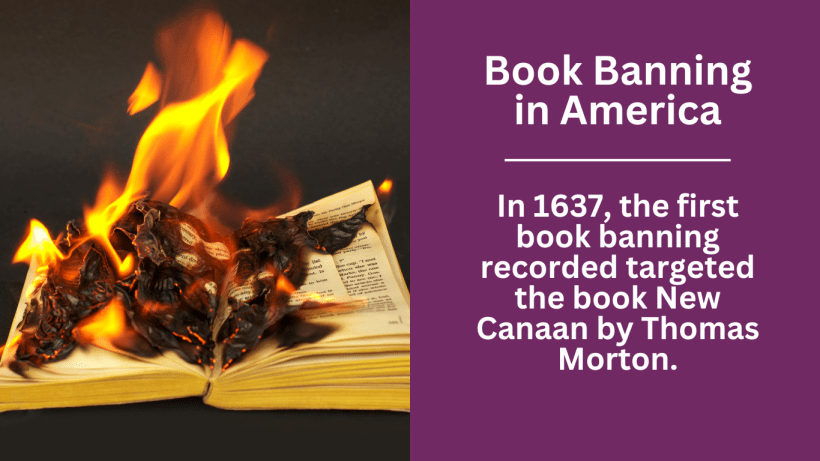
Book Banning in America: From Puritans to Public Libraries
In 1637, the first book banning recorded targeted the book New Canaan by Thomas Morton. The book was a three volume work of history, natural history, satire, and poetry. It was banned due to its accounts of the Puritans treatment of indigenous people.The Government said it was heretical and a harsh critique of Puritan customs and power structures. During this time frame, book banning was actually book burning. The first book to be burned would happen a short thirteen years later in Boston, Massachusetts
In the year 1873, the United States Congress enacted the Comstock Law. This law essentially allowed the government to prevent any work of literature or object deemed objectionable from being sent through the United States Postal Service. This act went on to further say that the federal government had the direct jurisdiction to make anyone who sold, gave away, or had in their possession anything the federal government deemed an obscene publication.
Let’s look at what that meant. Things that were considered obscene were items that contained erotica, contraceptive information, abortion information, sex toys, personal letters containing any information that may be alluding to sexual content or information, any information that contained any of the above items, and the prevention of medical journals since they contained information about contraceptive and abortion.
If you think this is all purely historical, lets keep in mind that in 2023, the American Library Association released a document that showed 4,249 unique titles that were targeted for censorship and banning. That was a 65% increase to a similar list in 2022. This censorship targeted library books, materials, and resources. These libraries were in schools and public libraries. That should scare you and if you would like to see the list of banned books, check them out here.
What should also scare you is that one state has the most books banned at over 1400. Something else that should be pointed out is that, right now, the top ten books being pushed to be banned in the country all share common themes. These are book that speak to the hardships that children often go through and offer a solace or path to getting through it easier. Or they are books that help teach children that, while they are different, they are, in fact, perfect the way they are. In a time where kids often need a sympathetic ear, these books give them that shoulder to lean on. Who else could do it? While we all went through it, our seperation from the age they are leaves us not understanding their struggles. We can offer little in the way of understanding and our guidance is often seen as coming from a place of disconnect and just being an adult.

Growing at the speed of the internet
Those who champion book bans tell us they are trying to protect our youth for divisive or dangerous thoughts and beliefs. They stand on soapboxes and tell us how many of these book are teaching kids about sex before they are ready or making them have negative views of our government and their families. Every year a piece of literature is cited as having and teaching offensive language/profanity, religious reasons, sexual references, and views on society. These are the very works of literature that want people to think for themselves, to question the reasons why we are told to think a certain way, and to look at the world through the eyes of another person and see its multitude of differences.
Adults say that literature teaches kids to be bad, to have sex before they are ready, and to not listen to authority. The truth is that books teach us to question rules for the effectiveness and relevance, to be different from those that came before us, and see the world in the multitude of colors, thoughts, sounds, and peoples that make it up. Words paint worlds with the colors of the mind, speaks to our hearts in music and emotion, and show us hidden pathways to a broader experience than what we can learn from people, alone.
Today, our kids are growing up faster than they have in the past, Reading is not a fundamental skill and more books are being removed from the hands of thirsty children. That leaves kids to learn things in unsafe places or from the internet. When you dont have a foundation to understand what is false information versus correct, you believe what is in front of you, especially when there is no evidence to prove otherwise. Today, kids learn more from Tik-Tok and Instagram than they do from actual books.
In 2021, 21% of adults in the United States are considered functionally illiterate. 54% have a literacy rate below a sixth grade level. The average American adult reads at a 7th or 8th grade level. As an example of the types of books considered to be on a seventh grade level are the Harry Potter series or The Hobbit by Tolkien. In 2013, 66% percent of children in the fourth grade could not read well, today those kids are 20 years old and are in the workforce. Who is left to teach the children when there is a strong chance that their parents are also functionally illiterate?

Live, Learn, Grow
The human mind is the most complex storage system on the face of the earth. It has the ability to reason, learn,and modify its existing thoughts with the addition of new information. This information is then used by the individual to find ways to interact with their environment and enrich themselves with lessons they learn. Those individuals then grow up to become the Albert Einsteins, Marie Curies, or Dr. Martin Luther King, Jrs. They could become the next wave of people who reshape our broken world to be the utopia we all dream of. Sadly, those people will never become who they are meant to be if we continue to reduce free thoughts and open access to information for people to grow and learn. It is time for us to realize our own limitations in out thought and rhetoric and not continue to pass it along to future generations.
What about you, how does the current rise of book bans make you feel? Are we reliving history or is this a much darker time than we have seen before? Do you agree with the need for limiting people’s access to books? If so, why? Let me know in the comments below. Remember the old adage that “Knowledge is power,” while keeping in mind that “With great power comes great responsibility.” It is our duty to challenge the thoughts and actions of the status quo, to want better for our futures, and to learn as much as we possible can to become the beings we are meant to be.


 Gay in the CLE