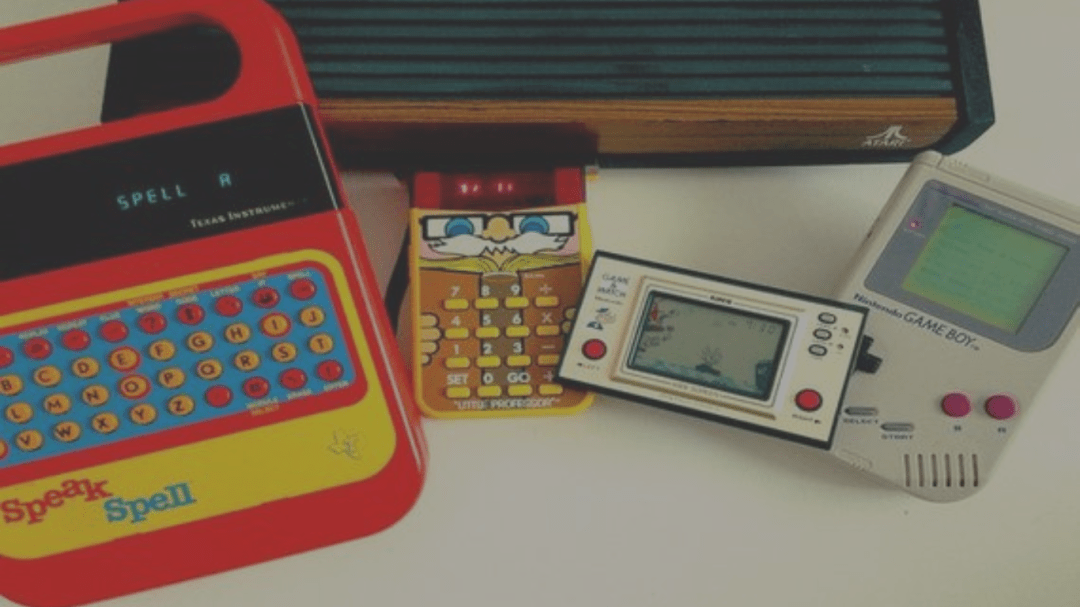
When we GenXers look back at the 1980s, we often do so wearing the most opulent rose colored glasses. It is easy for us to remember staying out late playing with our friends, Saturday morning cartoons, and music that simply has yet to be understood for its gifts to modern music. No matter how bright we remember those good times, in the back of our mind there lives a dark corner filled with all of the bad things that the 80s spat out. The problem is, we hoped and wanted them to be totally tubular when they ended up being grody to the max.
Join me today as we are transported back to a time of neon colors, spandex clad fashion, and hair that simply was meant to honor the gods as we look at Gnarly Gadgets From The 1980s That Were Bogus.
Tons of Tech Galore!
The 1980s was known as the generation of excess. From this decade, a group of people were born who had grown up hearing about all their parents did not have, due to wars and strictures placed on them. We saw plagues of drugs and disease sweeping over us and were fed up. War was everywhere and we simply wanted to live and party. It was a time of pushing technology boundaries, for good or bad. For the birth of the internet and how to access it. For inventors to give us their creations to make life easier so that we could enjoy other things. At the center of it all was this core belief of not doing it how it had always been done. We were the generation that took punk to new societal anarchist heights and gave the world toys like Furby and Teddy Ruxpin.
As a kid, The explosion of technology into my world was astonishing. I remember seeing my first science fiction movie at a drive in 1977 with my year old sister asleep in the car with us. If you haven’t figured it out, Star Wars was that movie. Star Trek had not been off the air for very long and each of them showed worlds where people had technology so intrinsic to their daily lives that you could not see where one ended and the other began. I wanted that, as well.
We witnessed the birth of home video gaming with the meteoric success of the Atari 2600 and it would not be long before computers would become small enough to become household additions. As the internet became more expansive, a new way of communicating was about to be given to the world.
This was the perfect confluence of forces that would allow inventors to dream big and swing for the stars. Some of them became mainstays, while others stayed in the dark only to be forgotten.

Wild Wild World of 1980s Computers
Imagine a time when computers were not tiny devices tucked in our pockets, but beasts that had to be leashed to desks! Oh, the 1980s, a decade filled with big hair, neon colors, and exciting technological wonders! Back in those days, computers were as cool as your first crush and just as mysterious. You had to press buttons and work your magic to make them come alive. These chunky machines might not have had the sleekness of today’s computers, but they had personality and charm like a beloved pet. Let’s hop into our time machine and explore the magical world of computers from the 1980s, where the journey was just as fun as the destination!

Macintosh Portable
Apple has always been known as a game changer. The 1980s showed that when Apple released the Macintosh Portable, the first ever laptop. There were no standards for form factors and the need for a portable computer had yet to be understood, the way that it is today. All of that rolled into one is why the Macintosh Portable never really fell far from the tree of Apple.
The Portable had an amazing active matrix display that was only in one other device at that time, also from Apple. Sadly, it did not perform well in low-light. It also used a lead-acid battery that could give up to 10 hours of power, for the non-back lit version. If the battery ever fully discharged, it became inoperable and you had a HUGE paperweight. Today you cannot find a single original battery that works, which means the Portable cannot even be powered on. However, the biggest reason for its failure was due to its price point.In 1989, it was released with a price tag of $7300.00 (about $17k in today’s dollars). That made this little Apple invention out of reach for most people who wanted one. Seems Apple continues with that pricing scheme, today.

Coleco Adam
Not every company in the 80s wanted to create some amazing new piece of technology. There were those that wanted to bank on their already known fame and create an extension of the brand. A way to bring other uses to their devices that you have already grown to love. The Coleco Adam was one of those systems.
ColecoVision was an American toy and video game company that already had a corner of the market with their ColecoVision game console. It was giving Atari a run for their money on home video game systems and was on the scene before Nintendo became the driving force they are now. The Coleco Adam was a home computer that was meant to be, both, an expansion of the game system and a stand alone model. If you already enjoyed the ColecoVision gaming system, this gave it more functionality. It seemed like this was a dream come true, a way for every user to get what they want. Sadly, the Adam was plagued with lukewarm reception and a list of defects that ranged from disk drive issues all the way up to producing a localized EMP. That’s right, every time you powered up this lovely little device, the power supply would release an electromagnet pulse so strong that it could scramble data that was left on any media in or near the system. It also wasn’t cheap to buy, coming in at $725 ($2130 today).

Techno Time Warp of 1980s Home Electronics
The 1980s promised us GenX kids a great many things were coming. Because of the Jetsons, we all assumed we would have flying cars in the early 2000s. Movies, like Short Circuit, were giving us the idea that robots would become an accepted part of life, and that we could communicate with people across great distances, as if they were in the same room with us. However, the truth of what we got, at that time, was vastly different than what seemed to be promised.

Video Phones
Telephones have been around for a long time and are so ingrained into our lives that there is no way of ever seeing ourselves without one, and thanks to cell phones we can take those precious calls wherever we want or need. Today, we can even FaceTime our friends with our phones so that we can feel like we are in the same room together.
Would it surprise you that this concept first came into reality in the 1970s? AT&T was the first, in 1970, to bring video conferencing to mainstream usage. Anyone was able to subscribe to their services to have the ability to have video conferencing in their homes or work. They offered two forms of service, one used standard telephone lines to transmit static images, taken every few seconds on the device, to the recipient. To transmit video, required their monthly service ($160/month) and an upgraded phone line. Sadly, this service was not like FaceTime. The phones were too expensive for the average phone user, the quality of the videos were terrible, and simply lack of comparative services made it flop before it could take off to what it is today.

Tomy Omnibot
The 80s made us believe that in the future, many of the common chores we took for granted, would be handled by robots. Flashforward today and mainly we see robots in manufacturing and the few small, around the house ones like Roomba and such. A toy company would be the one that wanted to bring robots to households to make their lives easier, that company was Tomy. Tomy created a rather large line of robots, but their popular model was the Omnibot 2000. This little droid came with many bells and whistles, like a cassette player that could record and playback sounds, an alarm clock, a carrying tray for beverages and more, and a remote control for functionality.
The biggest problem was that all of these robots had little in the way of intelligence, You either programmed in a small set of instructions or used a remote to control their movements. Also, as the video game crash of 1983 took its effects on people, their love of robots seemed to wane as well. Personally, I had two of them. The first was called the Tomy Dingbot, who was a bump and go bot with minimal vocalizations. Then there was the Verbot, which you could program movement routines into. It was limited as its range of motion was forward, reverse, left and right,. You could also program it to pick up and lift small items. The remote allowed you to speak the commands to it and it would perform them. Sadly, as a child I never got it to do much more than just spin in circles.

Take a picture, it’ll last longer
The 1980s brought a lot of technology that was previously out of reach of the average consumer into their households. As the cost of cameras came down and the added media on which you were able to record a photograph increased, it was rare you would ever see a family that wasn’t supporting a camera while on vacation or making memories at some location. That isn’t to say that there were not a lot of misses, when it came to consumer photography. Here are just a couple eateries.

Kodak Disc 4000
Kodak has long made itself a part of photography and film. In fact, they are one of the few that have been in the business as long as they have. With that track record, you would think most of their ideas were film gold. The Kodak Disc 4000 would prove you wrong. At its release, there was not a camera that looked like it anywhere on the market, for good reason. The Disc 4000 was an ugly design model but it was designed to fit in your back pocket and go with you anywhere. Sadly, the size would be part of its downfall.
With the creation of the Disc 4000, Kodak also had to create the film that would insert the Disc cartridge. Kodak wanted to give users the most amount of exposures in the smallest format possible. The disc allowed you to have 15 shots that were 10 mm in width. Compare that to 35mm film that gave you 36 shots. The quality of the images were subpar, creating grainy and fuzzy images that were under exposed. By 1988, the Disc 4000 disappeared into the vaults and left us with its lasting impression.

Fisher-Price PXL-2000
With the advent of camcorders in the 1980s, I had a brief moment of wanting to be a movie maker. I knew, unfortunately, the price point left me out of that dream. That was until I saw the Fisher-Price PXL-2000. And yes, you read that right, Fisher-Price put out a camcorder. That bad part is that it still retailed for $180, at the time.
Fisher-Price released this model that would use audio cassette tapes, instead of the standard VHS tapes. The bad of this was that the image quality was really low resolution and black and white. Price and quality were the biggest reasons this video camera did not last. Today, there is still a cult following of the PXL-2000 and you can find video across the internet filmed on these amazing devices. Do you want one? Check out eBay for working models.

Like – Totally Awesome Personal Devices
It is almost impossible to look around and not see someone with a personal assistant device. From smart watches to smart houses, we carry an array of personal devices with us daily. It would surprise most of the kids today to realize that these devices got their start at a much earlier time. Dick Tracy brought the idea of a watch that could talk to people, show images, and even store information for us. Even the phones we use today have their roots with devices like the Apple Newton and various other PDA iterations. Here are two of the groundwork devices that have shaped the industry of today.

Seiko UC-2000
I can honestly say that I cannot imagine how I would function, daily, without my Apple Watch. From tracking my runs to keeping me apprised of my health, it is an instrumental part of my daily life. While Apple has brought so many inventions to the market, the Apple Watch owes its beginnings to the Seiko UC-2000. Seiko deemed this watch as a “personal information processor” you can wear on your wrist. At the time it was released for $300. Plug this bad boy into its awkward wrist keyboard or the very large desktop dock and you could add text documents to it, do a few calculations, and even write some very basic computer programs.
The biggest problem with this amazing personal device was that it was ugly, even admittedly so by Seiko. So ugly in fact that they were very slow to bring them to the US for fear of how it would sell. As this was a limited LCD screen, it did not have the ability to show a GUI, like many computers of the time had. It also had a 2000 character limit on its storage, so you didn’t have a lot of things you could carry around on your wrist.

The Private Eye
VR glasses or HUDs (heads up displays) have had many entries into the tech market but most would be surprised to see that Google Glass had a grandfather called the Private Eye. The Private Eye was a head mounted display that used vibrating mirrors to scan a column of 280 LEDs across the user’s eye. These LEDs turned on and off rapidly to create each pixel on its screen. For the time, the display was amazingly sharp and was easy to focus on at different distances. The unit itself sat on your head using a mount and the display extended off that mount on an arm that was needed in a small opaque display. This did not affect your vision since our eyes use a shared system to combine and create the images we see.
Sadly, for many this usage of these head mounted displays often created nausea. This was a quality device created at the time. Ultimately, the reason for its failure was due to the fact that the equipment was heavy and uncomfortable. There just was not a market for it at the time. To this day, there really isn’t a market for this wearable tech.

Stepping stones to the future
The 1980s was a game changer, when it came to tech. It was the decade of excess and no limits. It allowed the gaming industry to start becoming the behemoth that we know it today and laid the foundation for our smartphones. We, as GenXers, expected so much for the future and were delivered on so little. Instead, our memories are filled with these Gnarly Gadgets From The 1980s That Were Bogus. Nonetheless, we saw the birth of some amazing tech that is still with us today and has been perfected in ways that the 80s and its inventors could not have guessed.
What about you, what technology from the 1980s do you remember and miss? Are there things you wish you could go back in time to relive? Maybe you weren’t born in the 80s and some of these devices sound really cool to you, which ones would you choose to have now? Let me know in the comments below.


 Gay in the CLE