
We are under attack! Make no mistake about it, there are political and religious groups who are advocating for removing any and all rights that we, as LGBTQ people, have at this very moment. Those rights, albeit limited, have come at the cost of blood, sweat, tears, and lives and the ones we have fought to get them from are poised to reclaim the hard won rewards we often take for granted as immovable.
There are freedoms and protections that are harder to remove, thanks to Supreme Court rulings or that often comes down to certain inalienable human rights that are easily refuted when targeted. But, there are those things we have not thought about in at least 50 years that have become a bigger focus. At present there are 22 states that have active bills targeting banning drag performances in public areas and places that minors may see them. The root of these bills is that the ones filing them say drag queens are lewd, lascivious, immoral, and produce sex invoking displays.
Make no mistake, these bills are only the beginning of what is to come.

Drag: art form, activism, and entertainment
It is believed, in some circles, that drag dates back to Ancient Greece. What we all need to remember is that in these ancient times, women were not allowed to perform on stage in public view. (Sound familiar) Those that say Greece is its earliest known origins said that it is the earliest form of female impersonation. Impersonation that came from the mindset that women were less than men, when it came to acting.
We do know that in the late 1800s, it was the United Kingdom that came up with the pantomime dames. If you are not familiar with pantomime dames, or panto as it is more commonly known, is a comedy sketch that often uses seriousness with a slight combination of opera to convey its entertainment. Essentially, it is men dressing up as women doing comedy and live singing. It is important to note that in the UK, panto is still popular, often have shows at Christmas time, and are open to the ENTIRE family. Also, during the 1800s, Molly Houses became popular. As being a homosexual in the UK in the 1800s was still illegal, many men would dress up in female attire and go to Molly Houses to meet other gay men and queer people.
Drag of today, especially in America, is nothing like this kind of drag. In America, drag has often been used to challenge the moral and social codes of society at a given point in history. It has been a means of artistic expression where no two drag performers are exactly alike. And, most importantly, it is a staple of the LGBTQ entertainment scene.
The first person to use drag as a form of activism was WIlliam Dorsey Swann, referred to as the Queen of Drag, was an LGBTQ activist in the late 1800s and early 1900s. Swann also created the first “drag house” where he hosted drag balls with his friends. He wanted to create and foster a community where people could be themselves and grow strength from it.
Drag ball culture wouldn’t take off until the Harlem Renaissance. It was at this time that New York City was becoming what it would be, it was considered the sociopolitical hub, the economy was growing in leaps and bounds, and more people were coming there by the day. Gender role issues seemed to also explode in the Black community. These issues caused the drag ball culture to explode, almost over night.
Loved by all
While drag has a political side, it has always been known as entertainment. It also has been a topic that each state has tried to sanction in some way. The fight never ends.
By the mid 1900s, drag passed as an almost acceptable type of entertainment by most Americans. A prime example would be to look at the old Studio 54 photos where you would see drag queens, drag entertainers all partying and having a good time with straight and LGBTQ people alike. Straight couples would venture to gay bars to watch a show, not protest it. But there is belief that it was more accepted because, at the time, our heterosexual brethren/sisters didnt know it was a part of LGBTQ culture. As more people felt that gay men were perverse or even worse, that stigma started to bleed over to the drag community.
By the 1960s and 70s, states had passed laws that targeted people who wore clothing that belonged to the opposite sex. If you wore more than three garments of the opposite gender, you could be arrested. Your arrest would be made public, alongside your picture, and had serious repercussions on your life. Make no mistake, the laws popping up all over our country are working to make this a reality again.
Over the last year or so, we have watched in horror as groups like the Proud Boys and various neo-Nazi groups have stormed into public sanctioned drag events, like drag story time, to protest, threaten, and harass the people running the show, as well as the attendees. In some places, it has gotten much worse. Even today, we hear stories of drag queens who are threatened in social media and in public for the shows they perform. Many of these threats go as far as threatening their lives. Sadly, little is ever done for the victims of these situations.
It’s okay for straights
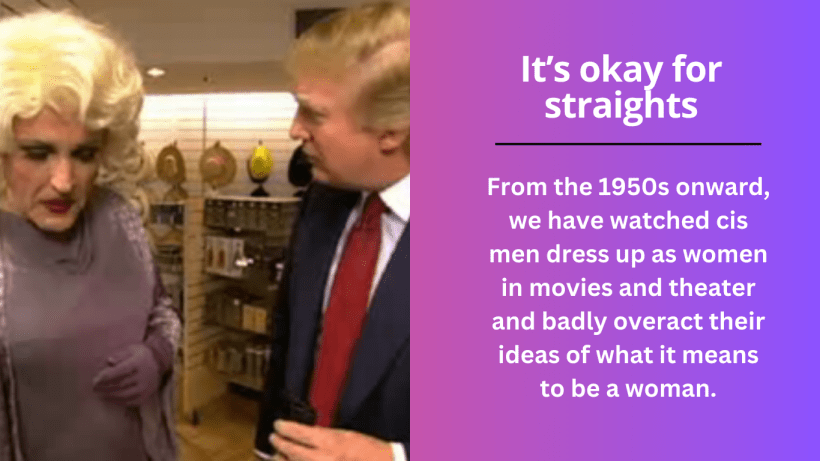
Picture it… The year is 2000 and a high society event where Donald Trump and Rudy Giuliani both dress up as women, badly, and flounce around in front of the amassed group. It was intended to be some sort of skit put on by the two. By the end of it, the brash bravado that Trump is often known for, led him to calling Giuliani beautiful and motorboating him, in front of everyone.
From the 1950s onward, we have watched cis men dress up as women in movies and theater and badly overact their ideas of what it means to be a woman. They present them in less than favorable fashion, usually as a bit dumb, oversexualised, and a big victim. We are all supposed to just sit here and accept that because they meant it out of jest. These very actions devalue and demoralize the very ideas of femininity.
Gay men, on the other hand, have used drag to lift up women and femininity. They may often exaggerate gender roles for feminine signifiers, but it isnt at the cost of making fun of women. For many, drag is the ultimate expression for someone they can pattern themselves after. To imbue themselves with the strength that women possess to fight the day to day battles they have to endure. It is meant to be a form of respect, not demoralizing their very natures.

Harsh realities near home
All across Ohio, and the country at large, we are seeing more and more bills being presented to ban drag performances in specific places or for people. Each person born in America or is a citizen of our great country has been given ‘certain inalienable rights’ and with that comes the ability for us to choose where to go and what to do, within the realm of the law. This is usually reserved for things like murder, theft, and such immoral human interactions, not a person putting on clothes of the opposite gender and performing for others. That is a freedom each of us still have.
Most recently, Bellefontaine, Ohio has a bill that is before the Board of Elections containing almost 800 signatures to have drag banned in public spaces or any location that may allow a minor to bear witness to the show. Communities are allowed to submit bills at any time for any reason, but they are also allowed to be challenged and removed from submission, as well. What they aren’t allowed to have done is change the wording of them, after they have collected the signatures and been turned in to the Board of Elections.
That is exactly what is being claimed by a group in Logan County.
In the bill that has been filed with the Board of Elections reads:
“The classification of drag artist(s) and drag shows as Adult Cabaret Performance. Adult orientated exhibitions featuring male or female impersonators who provide displays and entertainment appealing to sexual interest, shall not permit the attendance of a minor. Adult Cabaret Performances shall not be held on public property, or any location viewable by a minor.”
It is being claimed by a group of citizens that those petitions were changed after the needed signatures was received. That the earlier wording was not quite as stringent. These citizens have pictures of the original bill being passed for signatures and have compared them to the one on file with the Board of Elections and noticeable differences have been found. The biggest one is in newly classifying drag shows and performers as adult entertainment. This would make them on par with other, already recognized, forms of adult entertainment.

We are stewards of our culture
We sit at a place in history we have been at before. We, now, have factual historical evidence of what this very thing was like before we started achieving our hard fought for freedoms. We are witnessing those that wish to take them back from us and even impose new strictures on us. These are the very same people who troll gay dating apps looking for hookups with young guys, all while admonishing LGBTQ people for doing the same.The very same people who come to drag shows and act obnoxiously to performers. We should not even be tolerating this any longer, why are we not standing up to fight again?
How do you feel about all of the legislation that is being proposed or passed in our country that will take away our freedoms and could make drag shows illegal? Are you for it or against it? Maybe you don’t have an opinion at all or you think this is a nuisance that will go away in time. Let me know your thoughts in the comments below. We need to have open dialog with those working against us and we need to work together to ensure we do not slip backwards a few decades and lose all we have gained.


 Gay in the CLE