
There is one fact that seems to follow us, wherever we go. It is the fear of the unknown. Many people may say they aren’t afraid of things they don’t know but that usually comes from pushing beyond your fear and not letting it limit you, it doesn’t change the base nature we all have. But why do we fear that which we do not know? Even more, why does that fear of the unknown go to other parts of our lives, like dealing with people?
Homophobia hasn’t really gone anywhere, over the years. For many, it was buried beneath the surface because the current feeling of the world seemed to be that of acceptance. That all changed in 2016 with the election of one person into the American Presidency. Homophobia was pulled from the closets, forgive the pun, taken out of the attics or basements and brought back into the bright light of the world. The simple truth is that homophobia is rooted in fear, the fear of someone being different from who you are and having them questions who they really are.

The birth of homophobia
George Weinberg coined the term “homophobia”in the 1960s. It came from his observations of his colleagues’ discomfort in being around gay men and women.
“I coined the word homophobia to mean it was a phobia about homosexuals. It was a fear of homosexuals which seemed to be associated with a fear of contagion, a fear of reducing the things one fought for — home and family. It was a religious fear, and it had led to a great brutality, as fear always does.”
Jack Nichols and Lige Clarke used this near term in a column they wrote for Screw magazine on May 5, 1969. In this article they discussed the fears felt by straight men that they might be considered gay by others. This was the first time the term appeared in print. The word was brand new just a short 54 years ago.
Dr. Weinberg went on in his blog “Society and the Healthy Homosexual,” published in 1972, to say that “The term stood a central assumption of heterosexual society on its head by locating the ‘problem’ of homosexuality not in homosexual people, but in heterosexuals who were intolerance of gay men and lesbians.” By this definition, homophobia has little to do with homosexual people and more to do with preconceived ideas that heterosexual men have with homosexuals and the possibility of them being viewed as such.
What is ‘phobia’?
At its root, a phobia is an anxiety disorder that is categorized as an intense and irrational fear of a thing. We are familiar with many of them like arachnophobia (the fear of spiders, aerophobia (the fear of flying), and agoraphobia (the fear of an environment that is unsafe with no way to escape). These conditions cause extreme anxiety and can lead to panic. They can be so crippling that you refuse to interact in any way where the thing you are afraid of may actually be.
Does that mean that homophobia is the fear of homosexuals? And if not, how is it different?

Homophobia is more about disgust
In 2002, three University of Arkansas psychologists did a study to try to find the causes of homophobia. Most phobias rise from fear or anxiety, but according to their research, homophobia rises out of disgust instead. But a disgust in what?
During their studies, they also saw a link in homosexual tendencies as well as concerns about contamination and conservative views on sexuality. Meaning that people who may have homosexual tendencies and not acted on due to religious beliefs, may have higher amounts of homophobia. Their belief being more towards homosexuality going against religious views and tied to contaminating people with disease and homosexuality.
Since their findings lean more towards homophobia being more akin to racism and treatment of it should fall outside of the purview of psychotherapy. Their findings indicate that to remove homophobia from people would require a process of attitude reformation in places like home, schools, and other social places.
This seems to have a lot of creedence in relation to how homophobic violence is a growing concern again. If homophobia was more akin to a fear response, it would seem to indicate that heterosexuals would try to avoid situations involving homosexuals, like someone with arachnophobia. Instead, we are seeing violent beating that often lead to death, massive protests, and a huge outcry of how LGBTQ people are groomers and all around sinners.

Is homophobia about fear?
We have seen how homophobia has more in kin with racism than an actual phobia, but does that mean it is not rooted in fear? The answer isn’t quite so simple.
The term homophobia not being related to fear came to a culmination on March 6, 1995 on the then tabloid talk show, Jenny Jones. Most of her shows revolved around secret crushes and the link. On this show, Scott Amedure came on to reveal that he had a secret crush on someone he knew very well, a 24 year-old straight man named Jonathan Schmitz. After Amedure revealed to Schmitz that he had a crush on him, Amedure was found dead three days later from two gunshot wounds to the chest. The shots were fired by Schmitz and he was arrested. During the trial, the attorney for Schmitz used a new strategy that would forever be called the “gay panic defense.”
In the trial, Schmitz’s attorney disclosed that he had been diagnosed with manic depression (bi-polar disease) and a condition called Graves’ disease, these illnesses led him to commit murder based on his illnesses and humiliation due to Amedure being gay. The court found Schmitz guilty of second-degree murder and sentenced to 25-50 years in prison, after only spending 21 years in prison.
The gay panic defense has since become a defense in legal proceedings. It is defined as a strategy of legal defense in which a heterosexual person is charged with a violent crime because of an unwanted or perceived unwanted sexual advance made by a homosexual. The heterosexual person claims they have lost control and reacted violently because of this advance.
To go further in the homophobia also being a fear, it is perceived to stem from a fear of the presence of gay people and what they mean for society in general as well as being afraid that others will perceive them as a homosexual. These same people feel that things like marriage equality is a direct assault on the values of marriage and seek to destroy the family. There is a fear that queer people are shoving their sexuality down the throats of heterosexuals. These are the same people that state being queer is a lifestyle choice and that this lifestyle choice will, somehow, erase their identity. This leads to the fear that their children might be queer or worse, be turned queer by the world around them.
A good example of this kind of fear is watching heterosexual men in public situations. When two straight men are forced to sit near one another, they will always opt for an empty seat between them, mostly out of fear of people thinking they are a couple. To take it a step further, if a queer person has a close friend that is straight and comes out to them, many often ask if they are attracted to them, out of some fear they, too, will now be thought of as queer.
This fear goes on to other things, as well. Heterosexual men will often avoid things like wearing pink, jewelry, anything resembling a skirt, makeup of any kind, and a lingering hug between two men. All out of some perceived fear. Here is a good video. that talks more about how homophobia is still a fear of homosexuals and what needs to happen to change it.

The truth about homophobia
History has shown us that homosexuality is not an invention of the modern age, it has, in fact, been around since the beginning of time. Many ancient cultures often venerated homosexuality. Those same cultures had more open views on sexuality, as a whole. Native American tribes often had more than two genders and didn’t seem to cause any issues in their day to day lives. So when did this change?
Some history states that the intolerance of LGBTQ people started in the Middle Ages with the growing influences of Christianity and Islam. By the late 19th century, Western culture psychologists began viewing homosexuality as more than just a temporary behavior and that understanding it was immutable. As more people moved from rural areas to urban areas, same-sex attraction seemed to become more noticeable. With this increase in visibility, so did the increase in the phobia.
This escalated when Dr Sigmund Freud started giving child-rearing tips to parents to ensure their kids would grow up heterosexual. This is when we saw the rise I’m homosocial organizations like the Scouts and sports clubs as a means to ensure the masculine and feminine roles would be taught, respectively, to boys and girls.
The fear of homophobia is so strong that even queer individuals feel compelled to misrepresent who they are out of fear of persecution. On the flip side, proving one’s self as heterosexual is often more complicated than it is to prove someone homosexual. If you are perceived as liking anything that is closely related to what is thought of as homosexual then, by proxy, you are perceived as a homosexual.
The truth about homophobia is far more complicated than simply saying it is a fear of homosexuals or a disgust of the cultural and religious differences.
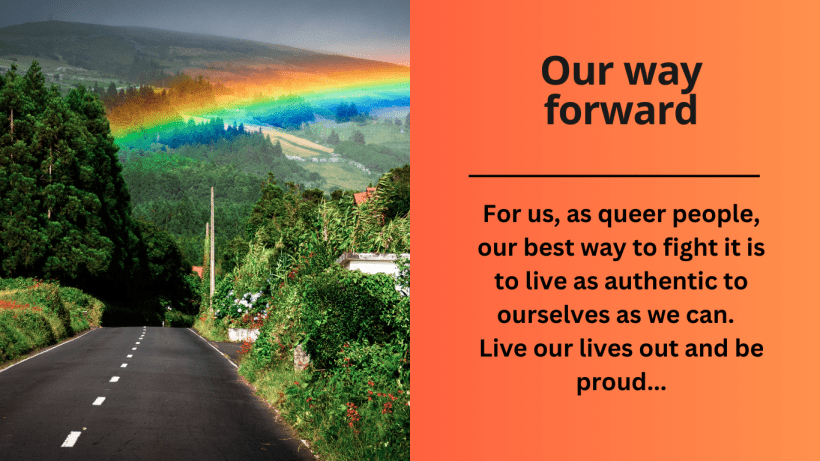
Our way forward
Combating homophobia is an event that needs to be addressed by all parties involved. For us, as queer people, our best way to fight it is to live as authentic to ourselves as we can. Live our lives out and be proud, don’t shy away from who you are and the things you like. By more of us being present in the public view, it forces others to see that we are people and that it is not just a stage in your life. We are as valid as they are.
What do you think about homophobia? Is it based more in fear or in the roots of hatred and disgust? Do you think we can ever truly be rid of homophobia? How do you combat it in your life, if you have openly faced it? Let me know in the comments below. Remember that your sharing may be the light someone else needs to navigate the tough spots they are going through. Thank you for reading.


 Gay in the CLE
Thanks for the awesome plug.
LikeLike
Thanks for the awesome plug
LikeLike
When unsettling and wavering thoughts, we are subject to varieties of negativities.
LikeLike