
I was taught, from a very young age, that to make big changes to your life required something called “willpower.” It was an illusive term, in my youth. I was made to believe that some people had lots of and others did not. I was told that if I could not change a habit that I had weak willpower. For years it colored my beliefs of what I could or could not do. That was until about three years ago when my boyfriend started to change the way I looked at it.
We’ve all been there. You set a goal for yourself, maybe something like going to the gym every day or cutting out junk food, and you swear you’re going to stick to it this time. But a few days or weeks in, you find yourself slipping back into your old habits. You start to feel like a failure, like you just don’t have enough willpower to make the changes you want to make. But what if I told you that willpower isn’t about strength of character at all? What if I told you that there’s no such thing as having a “weak” willpower? In this post, we’re going to explore the myth of willpower and why it’s not about having a superhuman level of self-control. We’ll look at the science behind willpower, why it fails us, and what we can do instead to make lasting changes in our lives.

The myth of willpower
Many of us have been taught to believe in the power of willpower. We are told that if we just had enough strength of character, we could accomplish anything we set our minds to. However, recent research has shown that this is simply not true. In fact, the idea of willpower as a finite resource that we can use to resist temptation has been debunked. It turns out that willpower is a complex interplay of biological, environmental, and psychological factors that are not entirely under our control. So, if willpower isn’t the key to achieving our goals, what is? This is the question that we’ll explore in this blog post. We’ll take a look at the latest research on willpower and self-control, and examine some alternative strategies that can help us achieve our goals without relying on sheer force of will.
What is willpower?
Willpower is a term that is often used to describe a person’s ability to resist temptation or to force themselves to do something that they don’t necessarily want to do. It’s commonly characterized as a type of mental toughness or strength of character.
However, willpower is actually a much more complex concept than just a simple demonstration of self-control. It’s an interplay of various cognitive processes, including attention, emotion, and decision-making, that allow individuals to regulate their behavior and make choices that align with their long-term goals.
Research has shown that willpower is not a fixed trait that people either have or don’t have, but rather a dynamic mental resource that can be strengthened or depleted depending on various factors such as stress, fatigue, and motivation.
Therefore, the idea that willpower is purely a matter of personal strength or moral virtue is a myth. Instead, it’s important to recognize that willpower is a complex and nuanced concept that requires a more nuanced understanding in order to effectively harness its power in our daily lives.

Why the myth persists
The belief in willpower has been around for a long time, and it’s easy to see why. It’s a comforting idea that we have control over our actions and can resist temptation through sheer force of will. This idea is perpetuated in the media, self-help books, and even by health professionals.
However, the reality is that willpower is not as simple as it seems. It’s influenced by many factors such as stress, sleep, and hunger. When we’re stressed, we’re more likely to give in to temptation. When we’re sleep-deprived or hungry, our ability to resist temptation is weakened.
In addition, our environment plays a huge role in our ability to resist temptation. If we’re constantly surrounded by junk food, it’s much harder to resist the temptation to indulge. Similarly, if we’re constantly surrounded by people who engage in unhealthy behaviors, we’re more likely to do the same.
The willpower myth also ignores the fact that we have limited mental resources. We can only make so many decisions in a day before our brain gets tired and we start to make poor choices. This is known as decision fatigue.
Ultimately, the willpower myth persists because it’s a simple idea that’s easy to grasp. It’s much more comforting to believe that we have control over our actions than to accept that there are many factors beyond our control. However, by understanding the limitations of willpower, we can develop strategies to help us make better choices and improve our overall health and wellbeing.

It’s not about strength of character
Many people believe that willpower is all about having a strong character. They think that if they just have enough discipline and self-control, they will be able to resist temptation and make the right choices. However, this is simply not the case.
Research has shown that willpower is actually a limited resource that can be depleted over time. This means that if you spend all day resisting temptation, you may have a harder time resisting in the evening when your willpower has been depleted.
Furthermore, willpower is influenced by a range of factors, including your environment, the people around you, and even your genetics. For example, if you are surrounded by unhealthy food options, it can be extremely difficult to resist temptation, no matter how strong your character is.
So, next time you find yourself struggling to resist a temptation, don’t beat yourself up and think that it’s because you lack strength of character. Instead, take a step back and consider the other factors that might be influencing your willpower. By understanding these factors, you can start to make changes that will help you make better choices and resist temptation more effectively.
The science behind willpower
Willpower is a term that is used to describe the ability to resist short-term temptations in order to achieve long-term goals. It is also known as self-control, self-discipline, or self-regulation. But what is the science behind willpower? How does it work in the brain?
According to research, willpower is a limited resource that can be depleted over time. This means that if you spend a lot of mental energy resisting temptations throughout the day, you are more likely to give in to them later on. This is known as ego depletion.
Ego depletion occurs because the brain uses glucose as a source of energy, and when glucose levels become depleted, willpower decreases. This is why you may find it harder to resist a piece of cake in the evening after a long day of work, than you would in the morning.
Research also suggests that willpower is influenced by both biological and environmental factors. For example, genetics can play a role in determining an individual’s level of self-control, as can childhood experiences and the social environment.
It’s important to understand the science behind willpower so that you can work with it, rather than against it. By taking steps to replenish your mental energy throughout the day, such as taking breaks, eating nutritious foods, and practicing mindfulness, you can increase your willpower and better achieve your goals.
It’s a finite resource
Willpower is often thought of as a superpower of the mind, allowing individuals to resist temptation and make better choices. However, research has shown that willpower is actually a finite resource, and the more you use it, the less you have left over.
Studies have shown that people who exert a lot of self-control in one area of their life, like resisting the urge to eat junk food, may have less willpower to tackle another task, such as focusing on work or studying. This is known as “ego depletion”.
So, what does this mean for the myth of willpower? It means that relying on willpower alone to achieve your goals may not be sustainable in the long run. Instead, it’s important to build healthy habits and routines that make it easier to make the right choices, without relying solely on willpower.
For example, if your goal is to exercise regularly, start by making it a routine. Schedule your workouts for the same time each day, or find a workout buddy to keep you accountable. This way, you won’t have to rely solely on willpower to get yourself to the gym.
Willpower is not an unlimited resource, and relying solely on it to achieve your goals may not be effective. Instead, focus on building healthy habits and routines that make it easier to make the right choices, and you’ll be on your way to success.
How to boost your willpower
Boosting your willpower is not about simply trying harder or being stronger-willed. Instead, it’s about developing habits and structures that help you avoid the need for willpower in the first place.
One way to do this is to make your goals more achievable. Break them down into smaller steps and celebrate your progress along the way. This will help you stay motivated and avoid the feeling of being overwhelmed.
Another way to boost your willpower is to eliminate temptation. If you’re trying to eat healthier, don’t keep junk food in the house. If you’re trying to quit smoking, avoid situations where you know you’ll be tempted to light up.
It’s also important to take care of yourself. Get enough sleep, eat well, and exercise regularly. These things will help you feel better overall and make it easier to resist temptation when it arises.
Don’t try to do too much at once, and don’t beat yourself up if you slip up from time to time. Instead, focus on building a foundation of good habits that will help you achieve your goals over time.
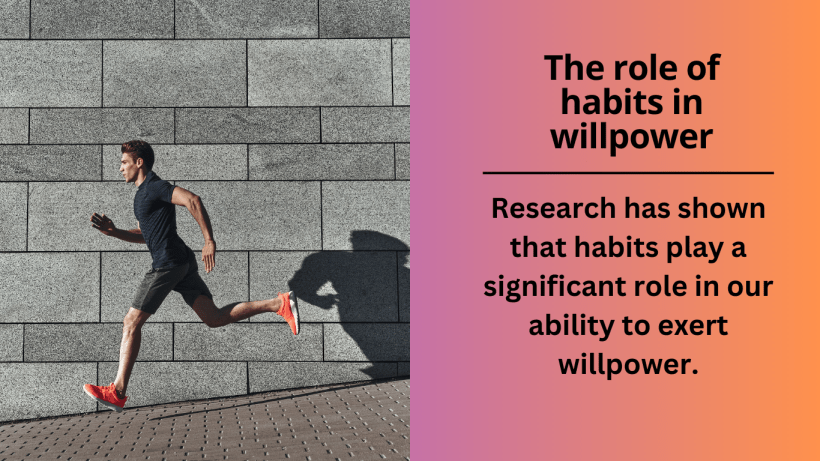
The roles of habits in willpower
When it comes to willpower, many people believe that it’s just a matter of having enough strength of character to resist temptation. However, the truth is that willpower is heavily influenced by our habits. Habits are the behaviors that we engage in automatically, without really thinking about them. They are the routine actions that we take each day, often without realizing it.
Research has shown that habits play a significant role in our ability to exert willpower. By developing good habits, we can actually make it easier to stick to our goals and resist temptation. For example, if you have a habit of going for a run every morning, you’re more likely to stick to that habit than if you rely purely on willpower to motivate yourself to exercise.
On the other hand, if you have a habit of snacking on junk food in the afternoon, it can be very difficult to resist that temptation, even with the strongest willpower. That’s because the habit is deeply ingrained in your brain and willpower alone is often not enough to break it.
So, if you want to improve your willpower and achieve your goals, the key is to focus on developing good habits. By creating routines and patterns that support your goals, you’ll find it much easier to stay on track and resist temptation, without having to rely solely on willpower.

Environment and willpower
When it comes to willpower and self-control, our environment plays a crucial role. Our environment can either support or hinder our ability to stay on track with our goals. If you’re trying to eat healthier, but your pantry is full of junk food, it’s going to be much harder to resist temptation.
One of the most important things you can do to improve your willpower is to set up your environment for success. This could mean removing unhealthy snacks from your home, or keeping your work area clean and organized to minimize distractions and increase focus.
Research has shown that visual cues can be powerful motivators. For example, if you’re trying to save money, putting a picture of your dream vacation destination on your fridge can help remind you of why you’re saving. Or, if you’re trying to exercise more, laying out your workout clothes the night before can make it easier to get out the door in the morning.
Another key aspect of our environment is the people we surround ourselves with. If you’re trying to quit smoking, hanging out with friends who smoke is going to make it much harder to stay on track. On the other hand, if you’re trying to exercise more, finding a workout buddy who shares your goals can help keep you accountable and motivated.
In short, the environment we create for ourselves can have a profound impact on our ability to stick to our goals and maintain our willpower. By being mindful of our surroundings and making intentional choices about how we set up our environment, we can set ourselves up for success and achieve our goals with greater ease.
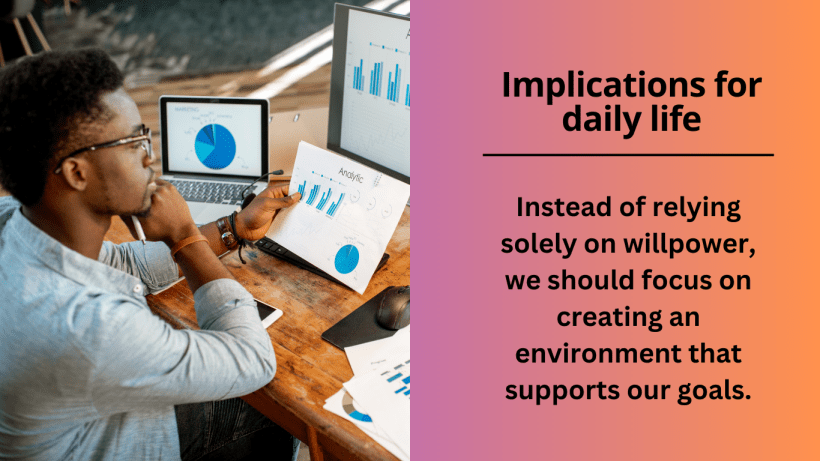
Implications for daily life
The myth of willpower is a pervasive one, but it’s time we let go of the idea that success is solely dependent on strength of character.
While willpower can be a helpful tool, it’s not the be-all and end-all when it comes to achieving our goals. We need to recognize that there are a multitude of factors at play in our daily lives that affect our ability to make decisions and take action.
Instead of relying solely on willpower, we should focus on creating an environment that supports our goals. This means setting ourselves up for success by removing obstacles and creating positive habits that make it easier to stick to our commitments.
We should also be kind to ourselves when we slip up, recognizing that setbacks are a normal part of the process. By approaching our goals with a sense of self-compassion, we’re more likely to stay motivated and keep pushing forward.
So, the next time you find yourself struggling to stick to your goals, remember that it’s not about strength of character. Instead, focus on creating an environment that supports your goals and be kind to yourself along the way. With these strategies in mind, you’ll be well on your way to achieving success in all areas of your life.
How do you feel about willpower? Do you think it is something you can work to get more of or is it a finite resource? How do you strengthen your willpower? Let me know in the comments below.


 Gay in the CLE